No tests. No grades. No pressure.

Just meaningful learning for curious teenagers.

Β 
Raise A Teen Who Can Think For Themselves

Help your teenager develop critical thinking, communication skills, and confidence in their own ideas through discussion-rich lessons exploring big questions, real-world issues, and fascinating debates.

Β 

JOIN THINKING DAY

The World Has Changed

Your teen can access answers in seconds.

AI can write essays.

Google can provide facts instantly.

But knowing information isn't the same as knowing how to think.

The teenagers who thrive in the future won't simply know more.

They'll know how to:

Question information

Consider different viewpoints

Communicate ideas clearly

Think critically

Β Form their own opinions

Navigate an increasingly complex world

These are the skills Thinking Day was designed to develop.

WHAT IS THINKING DAY?

Β 

One Big Question. Endless Possibilities.

Β 

Every Thinking Day lesson begins with a thought-provoking question.

Questions like:

Can AI Replace Human Creativity?

Should Schools Ban Mobile Phones?

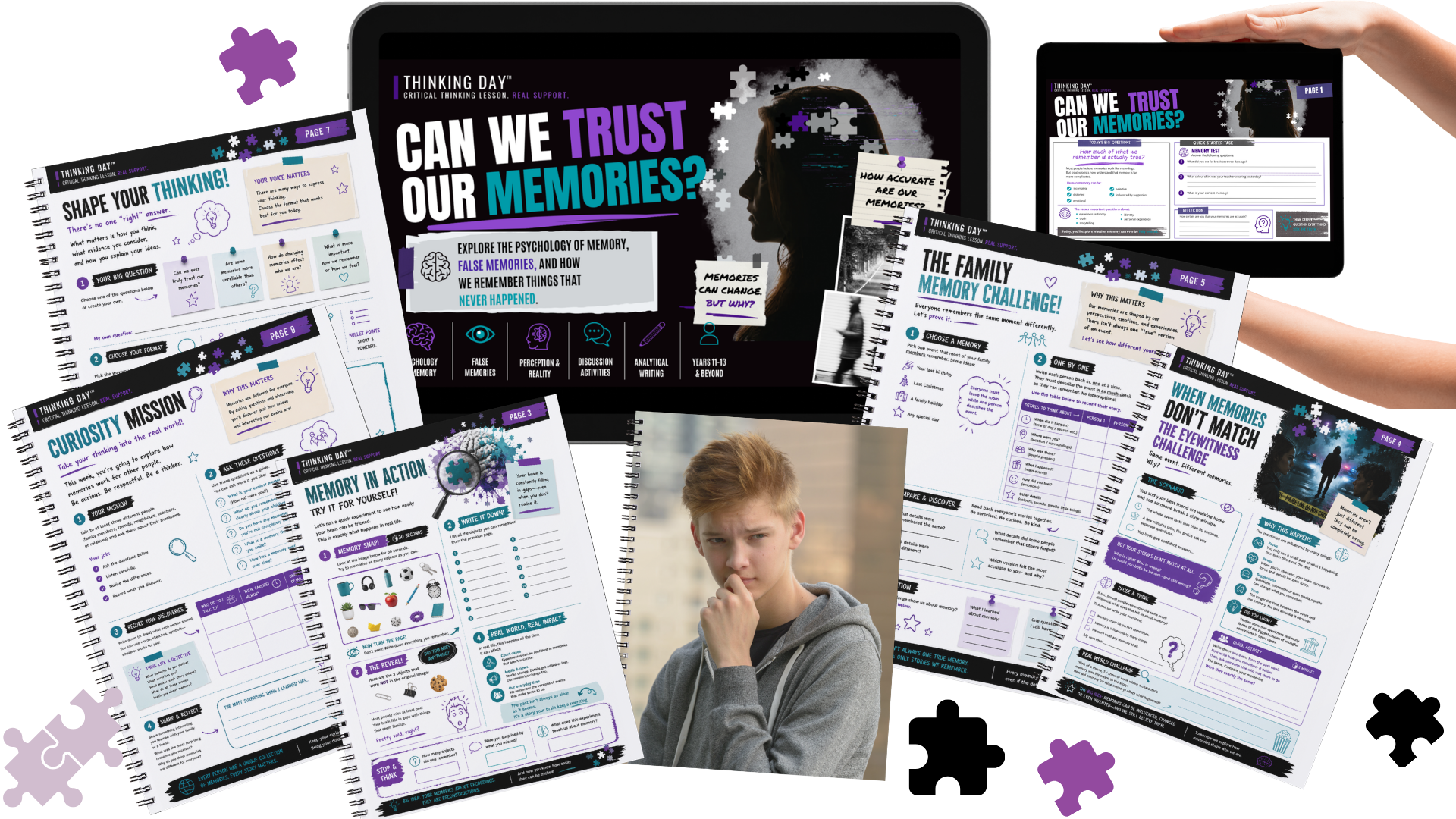
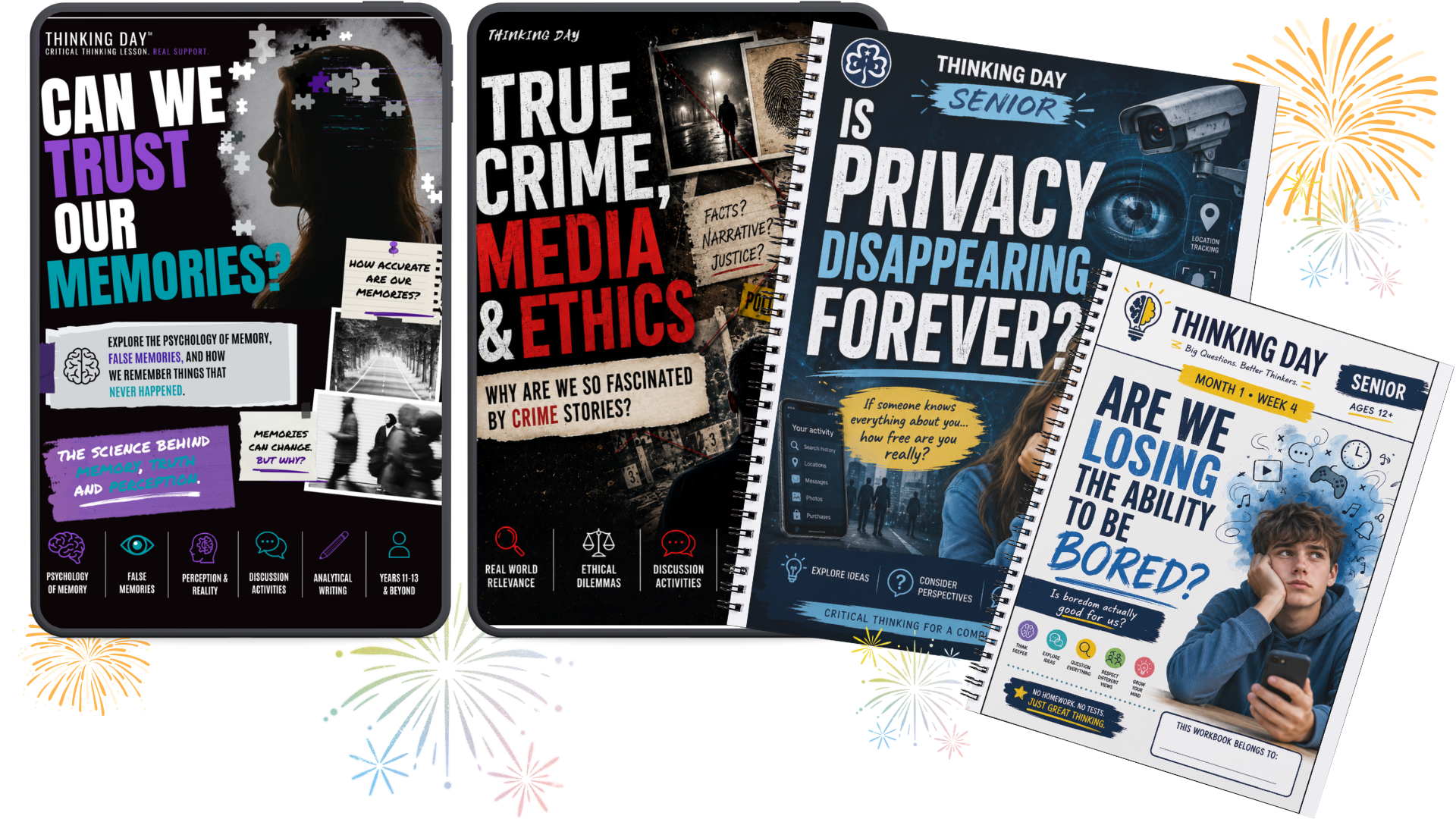
Can We Trust Our Memories?

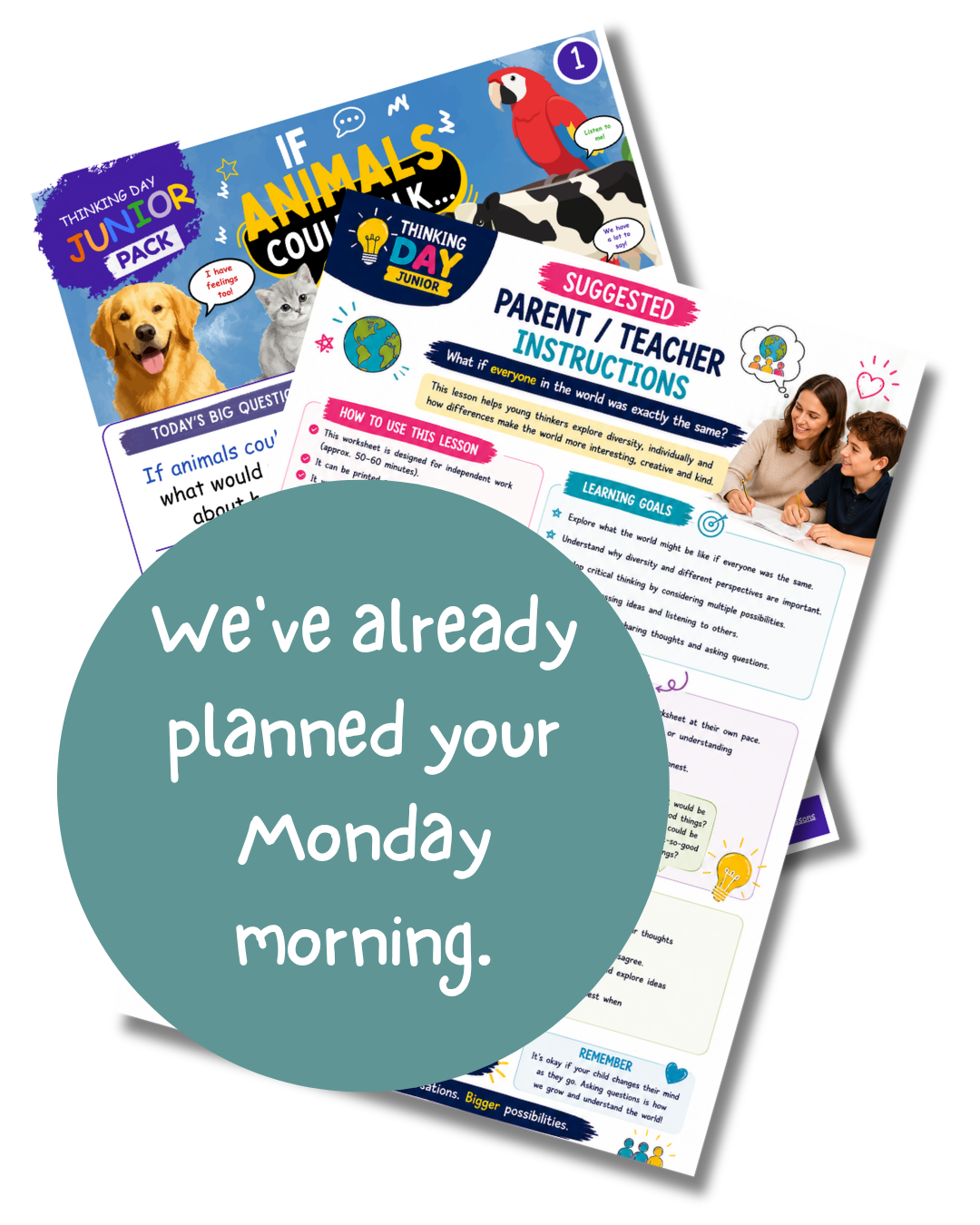
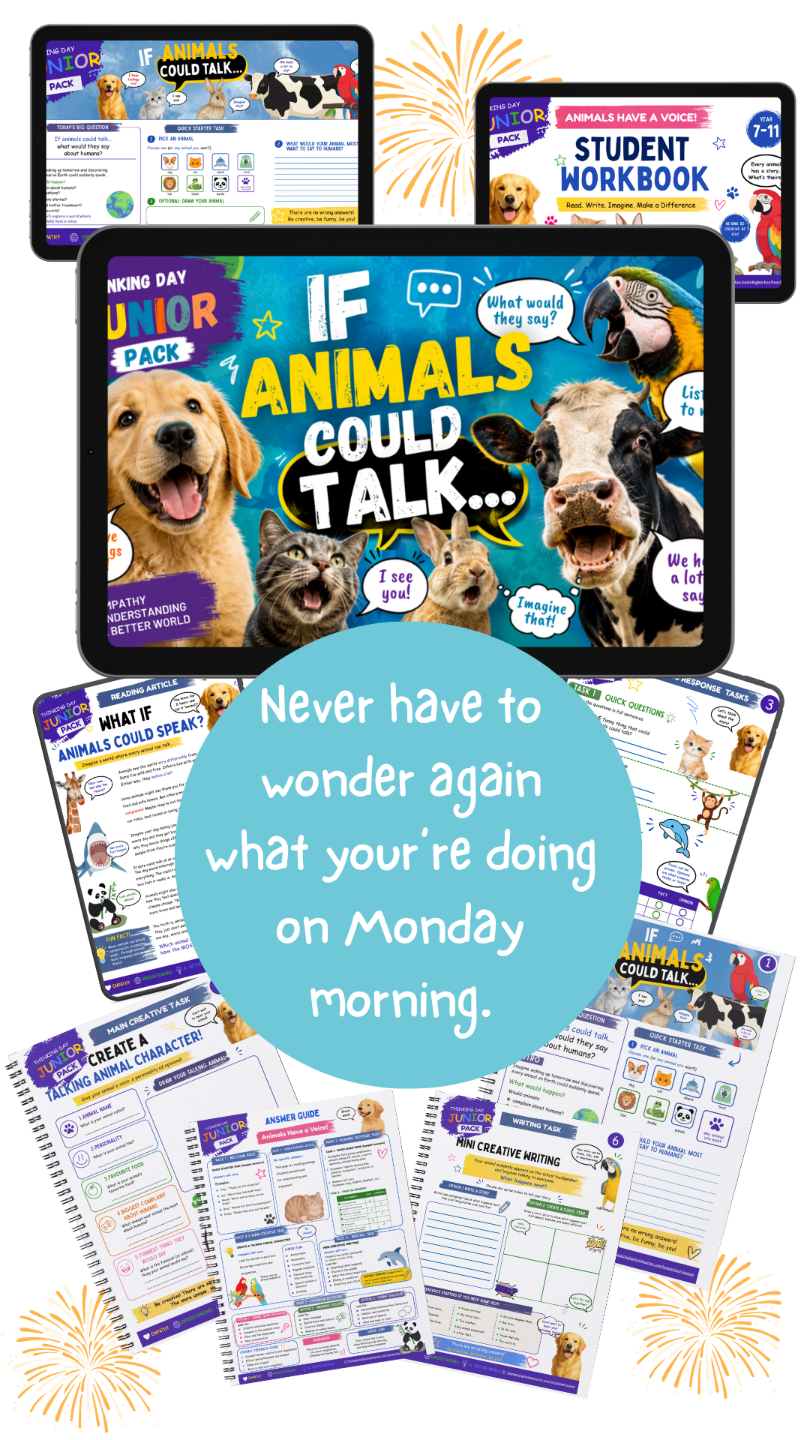
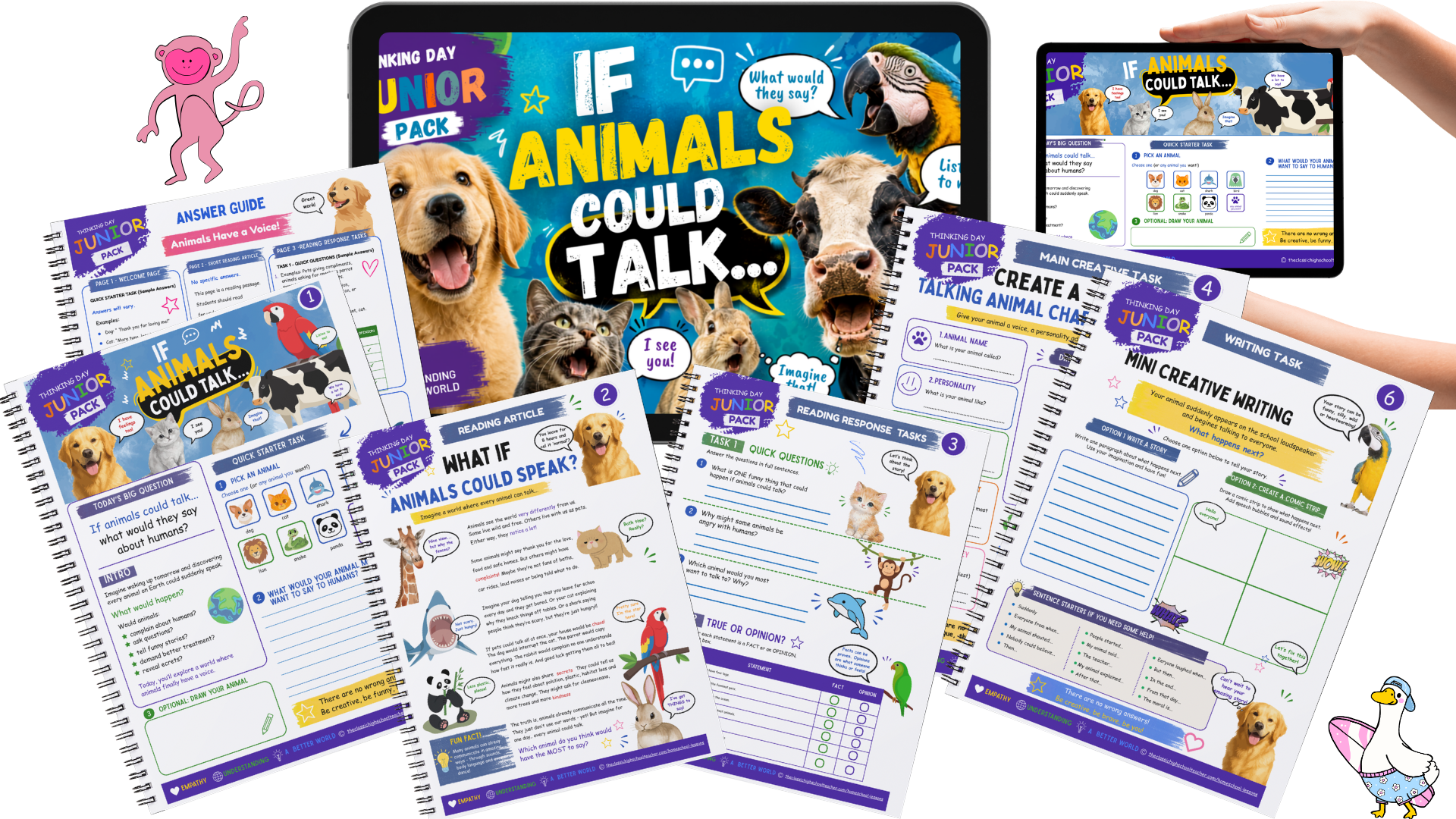
What If Animals Could Talk?

Does Money Buy Happiness?

Should Privacy Ever Be Sacrificed For Safety?

Through reading, discussion, reflection, and critical thinking activities, students explore different perspectives and develop confidence in their own thinking.

YES I WORRY ABOUT MY TEEN

THIS ISN'T MORE SCHOOLWORK

Most educational resources focus on finding the right answer.

Thinking Day focuses on asking better questions.

There are:

βœ“ No tests

βœ“ No grades

βœ“ No essays to submit

βœ“ No pressure to be perfect

βœ“ No model answers to memorise

Instead, students are encouraged to think, question, discuss, and explore.

MY TEEN NEEDS THESE SKILLS

PERFECT FOR

Homeschool Families

Meaningful educational experiences without hours of planning.

Curious Teenagers

For learners who enjoy exploring big ideas and asking questions.

Neurodivergent Learners

Discussion-rich, low-pressure learning that values different ways of thinking.

Families Wanting Less Screen Time

Thoughtful activities that encourage conversation and independent thinking.

INSIDE THE MEMBERSHIP

Every week you'll receive:

A new discussion-rich lesson
Reading and critical thinking activities
Reflection and opinion tasks
Real-world topics and debates
Independent learning opportunities
Printable and digital formats
A growing library of previous lessons

THE SKILLS YOUR TEEN WILL DEVELOP

Critical Thinking

Learning to question, analyse, and evaluate information.

Communication

Expressing ideas clearly and respectfully.

Perspective Taking

Understanding different viewpoints.

Independent Reasoning

Developing confidence in their own conclusions.

Curiosity

Exploring the world through questions rather than memorisation.

BROWSE THIS WEEK'S THINKING SKILLS

WHAT PARENTS LOVE MOST

Parents often tell us that Thinking Day sparks conversations that continue long after the lesson ends.

The goal isn't simply completing an activity.

The goal is helping teenagers engage with ideas that matter.

BROWSE THIS WEEK'S HOT TOPICS

SOME OF THIS MONTH'S THINKING SKILLS

Explore Big Questions Together

True Crime, Media & Ethics

A Ready-To-Go Critical Thinking & Media Literacy Lesson for Teens

True crime documentaries, podcasts, books, and television series have become one of the most popular forms of entertainment in the world.

Millions of people follow unsolved mysteries, binge-watch crime documentaries, and discuss criminal cases online.

But why are we so fascinated by crime stories?

And where is the line between raising awareness and turning tragedy into entertainment?

In this thought-provoking lesson, students will explore the psychology behind our interest in true crime, examine how the media presents criminal cases, and investigate the ethical questions that arise when real-life events become entertainment.

Students will consider multiple perspectives while exploring themes of justice, responsibility, media influence, privacy, victim representation, and public curiosity.

Along the way, they'll evaluate real-world examples, analyse different viewpoints, and reflect on the role true crime plays in modern society.

Students Will Explore:

βœ“ Why humans are naturally drawn to mystery and crime stories

βœ“ The rise of true crime podcasts, documentaries, and online content

βœ“ How media shapes public perceptions of crime and justice

βœ“ Ethical questions surrounding true crime entertainment

βœ“ The impact of true crime on victims, families, and communities

βœ“ The balance between public interest and personal privacy

Students Will Discuss:

βœ“ Why do people enjoy true crime stories?

βœ“ Is true crime educational or exploitative?

βœ“ Should some cases be turned into entertainment?

βœ“ Do true crime documentaries help or harm the pursuit of justice?

βœ“ What responsibilities do creators have when telling real-life stories?

βœ“ Where should the line be drawn between information and entertainment?

Perfect For:

Media Studies

English

Social Studies

Homeschool learning

Critical thinking activities

Discussion-based learning

Independent work

Media literacy lessons

Big Question:

Does true crime help us better understand society and justice, or does it risk turning real human suffering into entertainment?

This engaging lesson encourages students to think critically about media consumption, ethical decision-making, and the powerful influence stories have on how we understand the world around us.

Β 
Β 
Add to Cart $9

Would You Survive a Zombie Apocalypse?

A Ready-To-Go Critical Thinking, Survival Strategy & Human Behaviour Lesson for Senior Teens

The zombie apocalypse has become one of the most popular fictional scenarios in movies, books, games, and television.

But beyond the zombies lies a fascinating question:

Would you actually survive?

In this engaging lesson, students will explore the decisions, challenges, and ethical dilemmas people might face during a large-scale survival crisis. From choosing who to trust to deciding what supplies to take, students will be challenged to think critically, solve problems, and justify their decisions under pressure.

Along the way, they'll examine themes of teamwork, leadership, human behaviour, resource management, and survival while exploring what happens when society's normal rules disappear.

Students will discover that surviving isn't just about strength or luckβ€”it's about planning, adaptability, decision-making, and working effectively with others.

Students Will Explore:

βœ“ What people need to survive during a major crisis

βœ“ How teams make decisions under pressure

βœ“ The importance of leadership and cooperation

βœ“ Ethical dilemmas that arise during survival situations

βœ“ Human behaviour in times of uncertainty

βœ“ The skills that increase the chances of survival

Students Will Discuss:

βœ“ What would you do in the first 24 hours of a zombie outbreak?

βœ“ Which survival skills are most important?

βœ“ Would you prioritise yourself, your family, or your community?

βœ“ How do groups make decisions when resources are limited?

βœ“ What makes a good leader during a crisis?

βœ“ Would society become more cooperative or more selfish?

Perfect For:

Homeschool learning

Critical thinking activities

Relief teacher lessons

Discussion-based learning

Creative writing

Team-building activities

Independent work

Problem-solving challenges

Big Question:

When everything familiar disappears, what qualities and decisions give people the best chance of survival?

This high-engagement lesson encourages students to think strategically, solve complex problems, explore ethical dilemmas, and examine how humans respond when faced with uncertainty, risk, and survival.

Add to Cart $9

Is Social Media Making Us Less Human?

A Ready-To-Go Critical Thinking, Psychology & Digital Culture Lesson for Teens

Social media has transformed the way we communicate, build relationships, learn, and spend our time.

But as our lives become increasingly connected online, an important question emerges:

Is social media bringing us closer togetherβ€”or pulling us further apart?

In this thought-provoking lesson, students will explore the impact social media has on human behaviour, relationships, attention, identity, empathy, and modern society. They'll investigate both the benefits and challenges of digital communication while considering how technology is shaping the way we interact with one another.

Through discussion, debate, reflection, and critical thinking activities, students will examine multiple perspectives and evaluate whether social media is enhancing human connection or changing what it means to be human.

Along the way, they'll explore the psychology behind online behaviour, the influence of algorithms, and the role social media plays in everyday life.

Students Will Explore:

βœ“ How social media influences communication and relationships

βœ“ The psychology behind likes, notifications, and online engagement

βœ“ The impact of social media on empathy, attention, and identity

βœ“ The benefits and challenges of digital connection

βœ“ How technology shapes modern society

βœ“ The role algorithms play in what we see and believe online

Students Will Discuss:

βœ“ Is social media making people more connected or more isolated?

βœ“ Can online friendships be as meaningful as face-to-face relationships?

βœ“ How does social media influence the way we see ourselves?

βœ“ Are we becoming too dependent on technology?

βœ“ Who is responsible for the effects of social mediaβ€”users or platforms?

βœ“ What might society look like without social media?

Perfect For:

Media Studies

English

Social Studies

Homeschool learning

Critical thinking activities

Digital literacy lessons

Discussion-based learning

Independent work

Big Question:

Is social media helping us become more connected and informed, or is it slowly changing the way humans think, communicate, and relate to one another?

This engaging lesson encourages students to think critically about technology, human behaviour, and the digital world they navigate every day while exploring one of the most important questions facing modern society.

COMING SOON

If You Could Invent Anything...

A Ready-To-Go Creativity, Innovation & Future Thinking Lesson for Teens

Every invention starts with a question.

What if there was a better way?

From smartphones and electric cars to life-saving medical devices and space exploration, many of the world's greatest inventions began with someone imagining something that didn't yet exist.

But if you had the opportunity to invent anything...

What would you create?

In this imaginative and engaging lesson, students will explore the power of creativity, innovation, and problem-solving while designing inventions that could improve lives, solve real-world challenges, or completely transform the future.

Students will discover how inventors identify problems, generate ideas, test solutions, and turn imagination into reality.

Along the way, they'll examine famous inventions, think creatively about future possibilities, and develop their own unique ideas for products, technologies, services, or solutions the world has never seen before.

Students Will Explore:

βœ“ How inventions change the world

βœ“ The role of creativity in solving problems

βœ“ How inventors identify opportunities and needs

βœ“ Future technologies and innovations

βœ“ The invention process from idea to creation

βœ“ How imagination can drive real-world change

Students Will Discuss:

βœ“ What problem would your invention solve?

βœ“ Which inventions have had the biggest impact on society?

βœ“ What inventions might exist in the future?

βœ“ Can technology solve every problem?

βœ“ What makes an invention successful?

βœ“ How can creativity help improve the world?

Perfect For:

Homeschool learning

Critical thinking activities

STEM enrichment

Creative thinking lessons

Independent work

Discussion-based learning

Future-focused learning

Innovation and entrepreneurship activities

Big Question:

If you could invent anything to improve the world, what would you createβ€”and how would it change people's lives?

This engaging lesson encourages students to think creatively, solve problems, explore future possibilities, and develop the confidence to turn big ideas into meaningful solutions.

Add to Cart $9

The World's Weirdest Laws

A Ready-To-Go Critical Thinking, Law & Society Lesson for Teens

Did you know there are places where it's illegal to carry an ice cream in your pocket, impossible to die inside parliament, or against the law to leave a banana peel in certain locations?

As strange as they sound, many unusual laws really do exist.

But why were these laws created in the first place?

And who decides which rules make sense?

In this entertaining and thought-provoking lesson, students will explore some of the world's strangest real-life laws while investigating how rules shape society, influence behaviour, and reflect the values of different cultures.

Students will discover that even the most unusual laws often have surprising origins and that legal systems are constantly evolving as societies change.

Along the way, they'll evaluate bizarre regulations, debate whether certain laws are fair, useful, or outdated, and consider what makes a good law in the first place.

Students Will Explore:

βœ“ Some of the world's strangest real-life laws

βœ“ Why unusual laws were created

βœ“ How laws help societies function

βœ“ The relationship between rules, fairness, and freedom

βœ“ How laws change over time

βœ“ The role governments play in creating and enforcing laws

Students Will Discuss:

βœ“ Which weird laws make senseβ€”and which don't?

βœ“ Should outdated laws be removed?

βœ“ Can a law be legal but still unfair?

βœ“ How much freedom should people have?

βœ“ What makes a good law?

βœ“ If you could create one new law, what would it be?

Perfect For:

Homeschool learning

Critical thinking activities

Civics and citizenship

Social Studies

Relief teacher lessons

Discussion-based learning

Independent work

Current events and society lessons

Big Question:

What makes a law fairβ€”and who gets to decide which rules society should follow?

This engaging lesson encourages students to think critically about rules, fairness, responsibility, and the role laws play in shaping everyday life while discovering some of the most unusual regulations ever created.

Download Free Sample Pack

Frequently Asked Membership Questions

Β 

How often will new lessons be released?

New Thinking Day lessons are added every week, giving your teen a growing library of thought-provoking topics, debates, and critical thinking activities to explore throughout the year.

Can I cancel at any time?

Absolutely.

There are no contracts or lock-in periods. You can cancel your membership whenever you like.

What happens if I cancel?

You'll continue to have access until the end of your current billing period. After that, access to the membership library will end unless you choose to rejoin.

Do we have to complete a lesson every week?

Not at all.

Many families complete a lesson every week, while others dip into the library whenever they need a meaningful learning activity, discussion topic, or screen-free educational experience.

The membership is designed to fit around your family, not the other way around.

My teen isn't a strong writer. Will this still work?

Yes.

Thinking Day is built around ideas, discussion, and critical thinking rather than formal essay writing.

Many activities can be completed through conversation, reflection, short responses, or verbal discussion.

My teen is neurodivergent. Is this suitable?

Many neurodivergent learners thrive with Thinking Day because the lessons are discussion-rich, low-pressure, and focused on exploring ideas rather than finding the "right" answer.

Teens are encouraged to think in their own way and engage with topics at a pace that suits them.

Do I need to teach the lessons myself?

Not necessarily.

Many teenagers work through large parts of the lessons independently. Parents can be as involved as they like, whether that's facilitating discussions or simply providing the lesson and letting their teen explore it independently.

Is this only for homeschool families?

No.

While many homeschool families enjoy Thinking Day, the lessons are also popular with parents looking for meaningful screen-free activities, enrichment opportunities, or ways to encourage deeper thinking and conversation at home.

Will my teen receive certificates, grades, or assessments?

No.

Thinking Day focuses on curiosity, critical thinking, and discussion rather than formal assessment.

The goal is to help teenagers become confident thinkers, not to create more schoolwork.

Why a membership instead of individual lessons?

Because critical thinking develops over time.

One great discussion can spark curiosity.

A year of meaningful questions can help shape how a teenager thinks, communicates, and engages with the world.

Start Exploring

Choose a topic that interests your family and start learning together today.

Real topics.

Real learning.

Real conversations.

EXPLORE THIS WEEK'S THINKING SKILLS PACKS
JOIN THE MEMBERSHIP & SAVE $12 A MONTH

Join the Membership & Save!

Every month you'll receive four newΒ critical thinking packs that caters to a range of learning abilities.

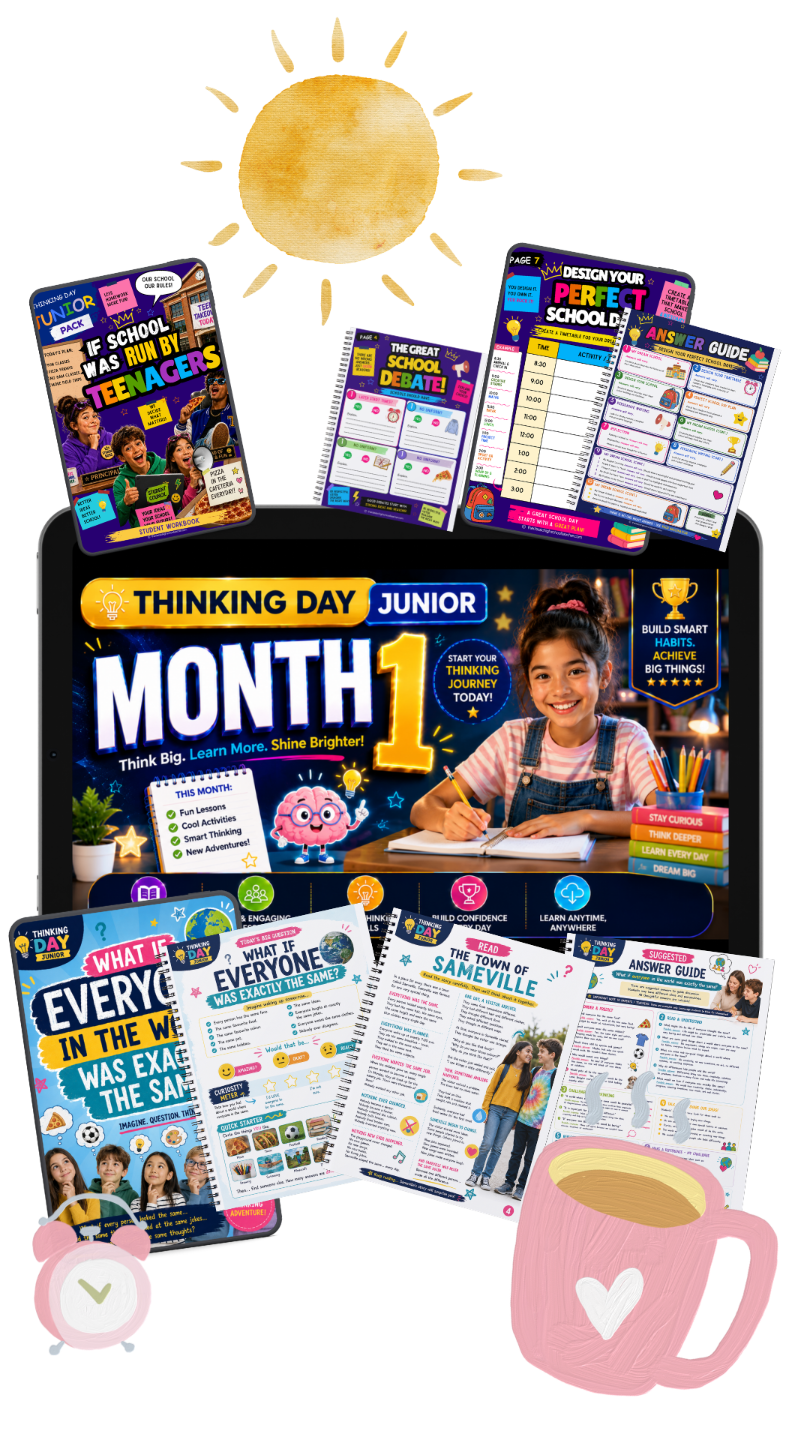
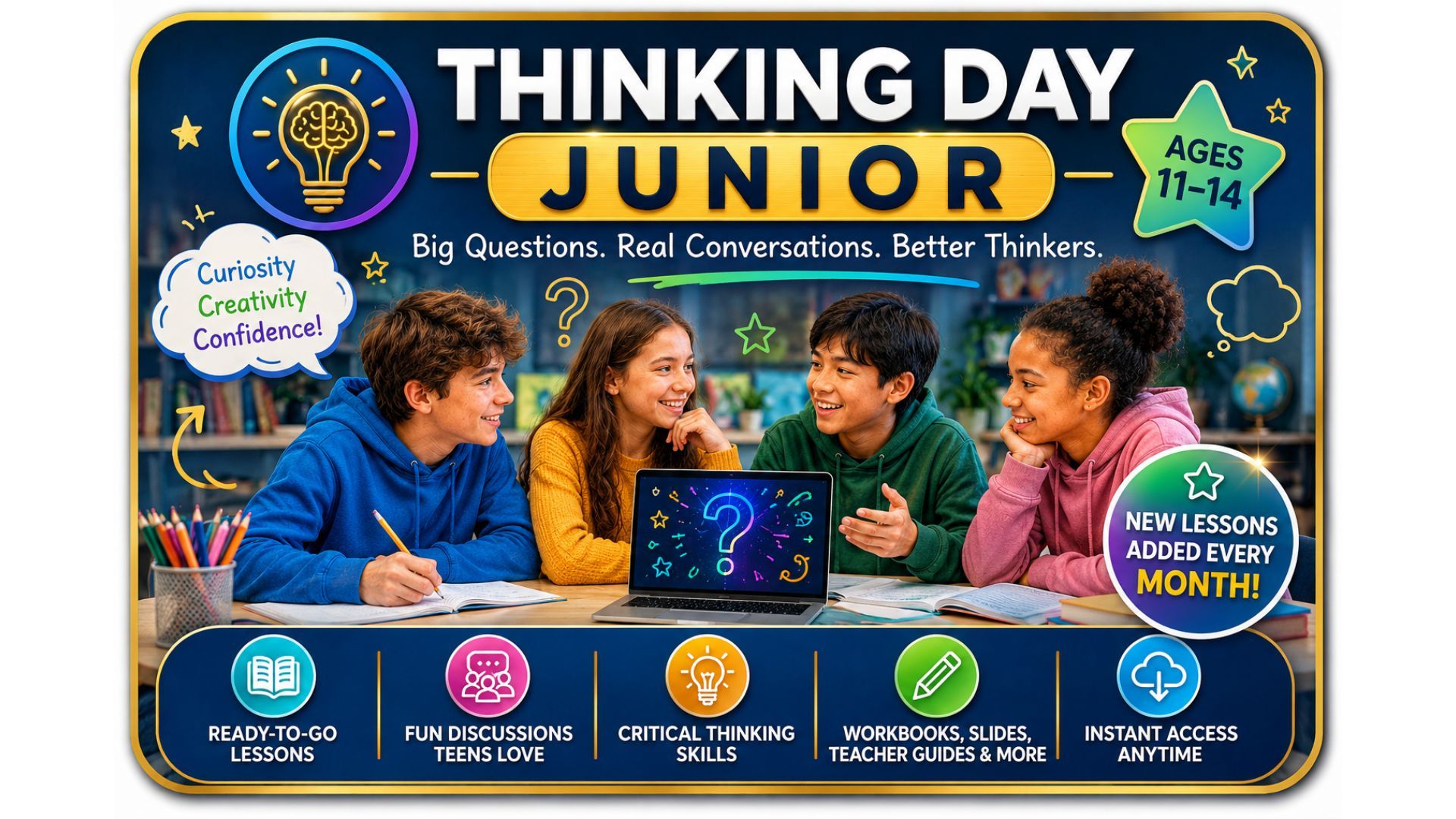
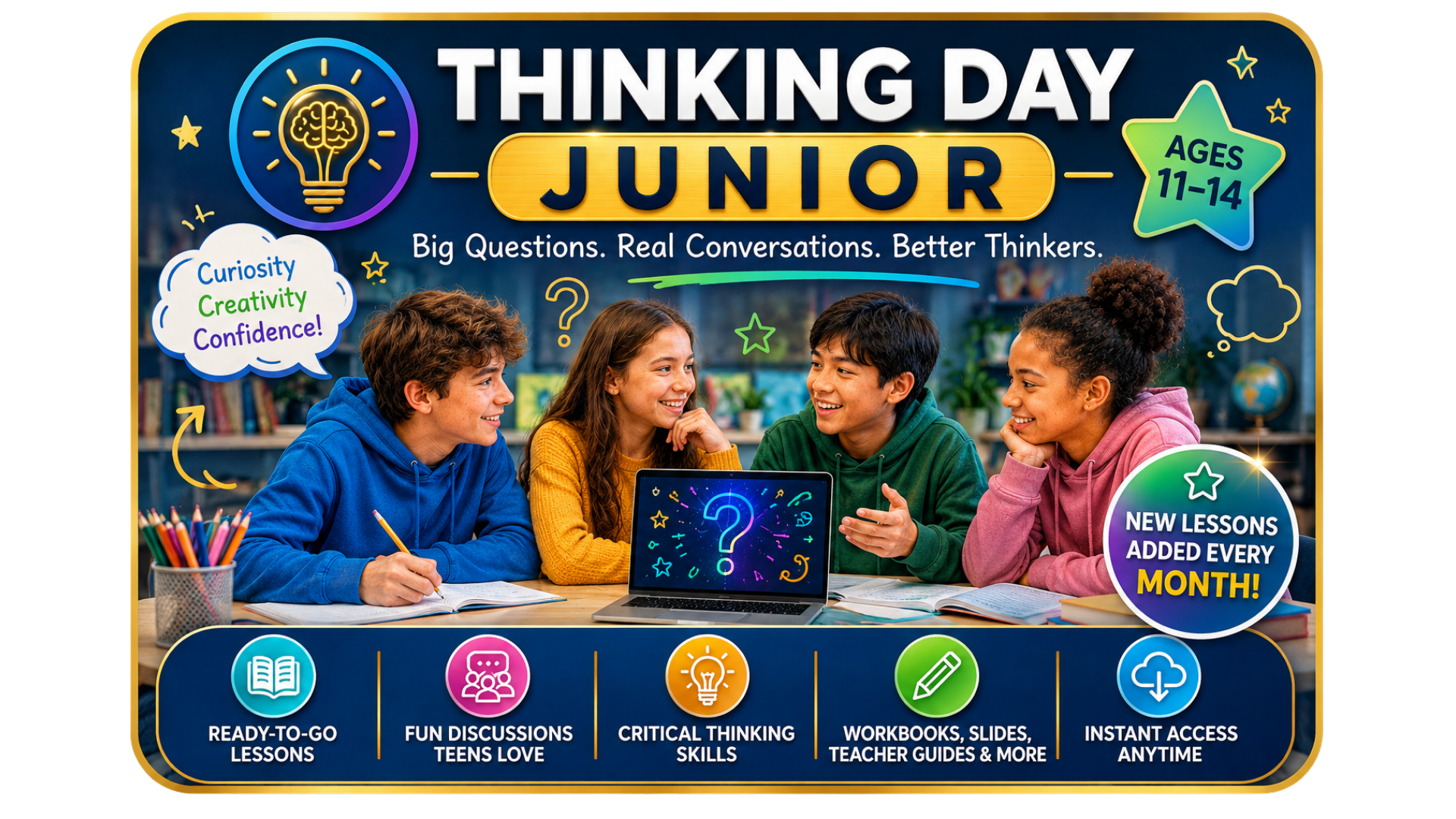
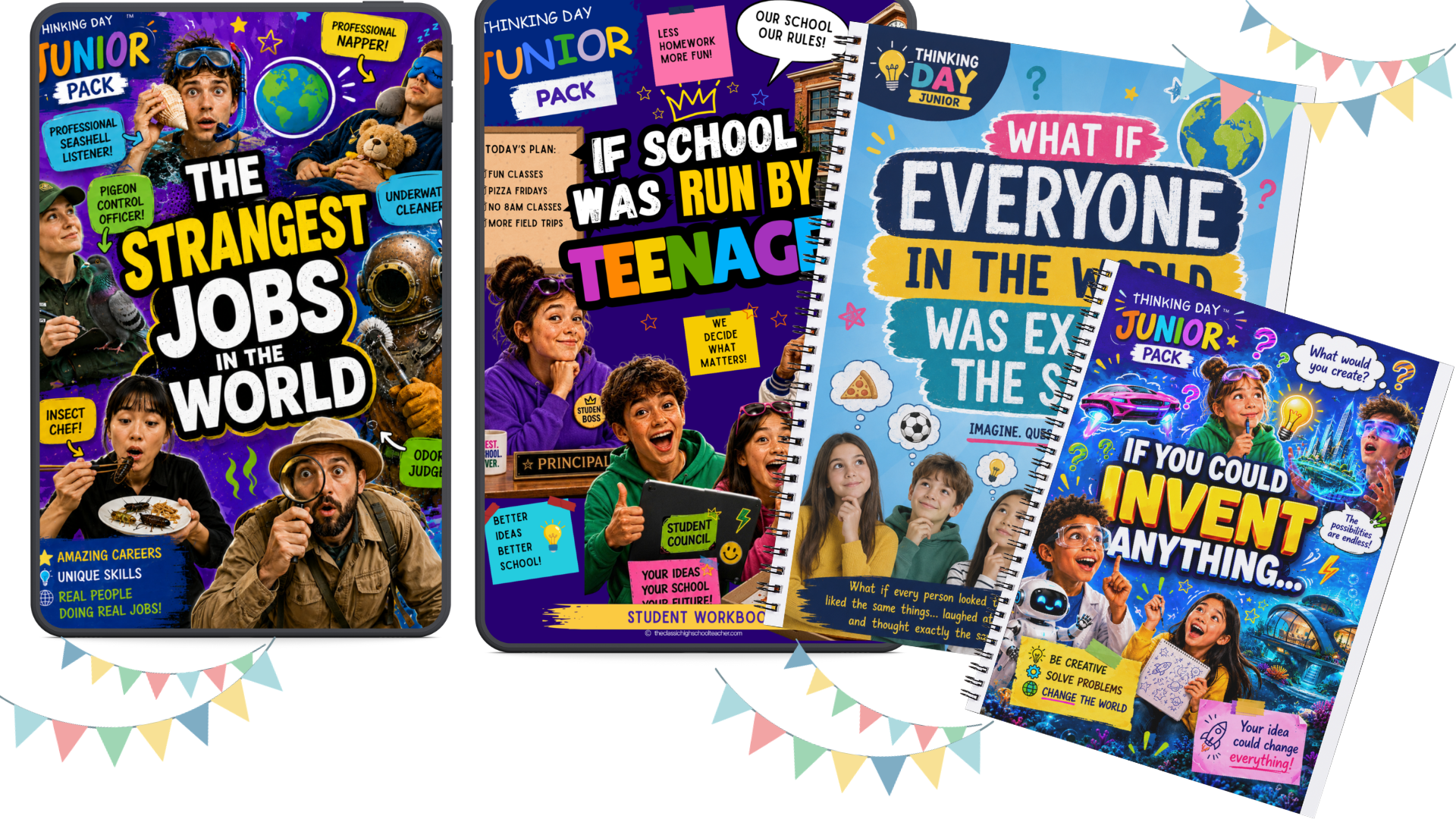
Thinking Day Junior

Ages 11-14

Big questions designed to spark curiosity, creativity, discussion, and critical thinking.

Perfect for younger teens who are developing confidence in expressing their ideas and exploring the world around them.

Example Topics

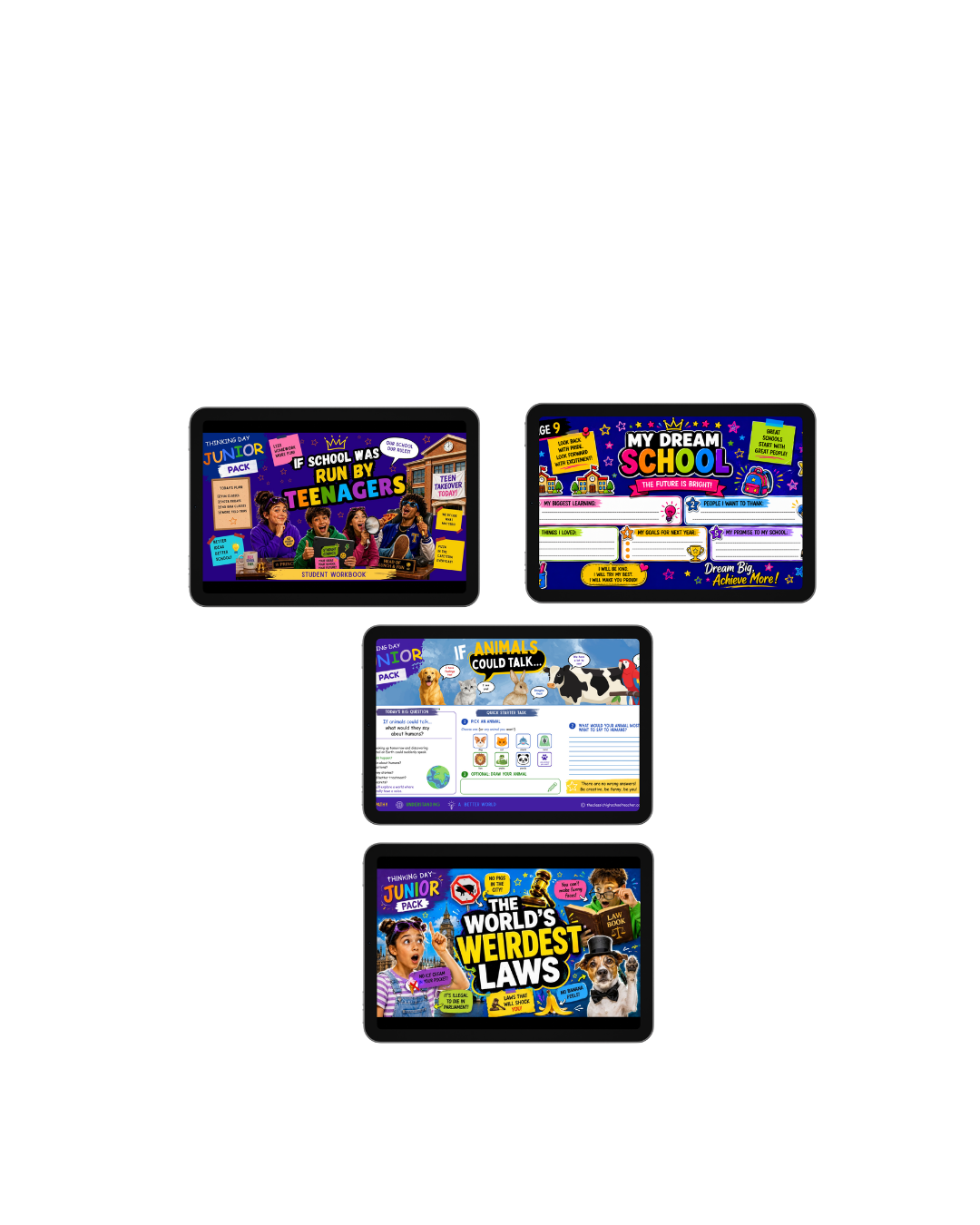
βœ“ If Animals Could Speak

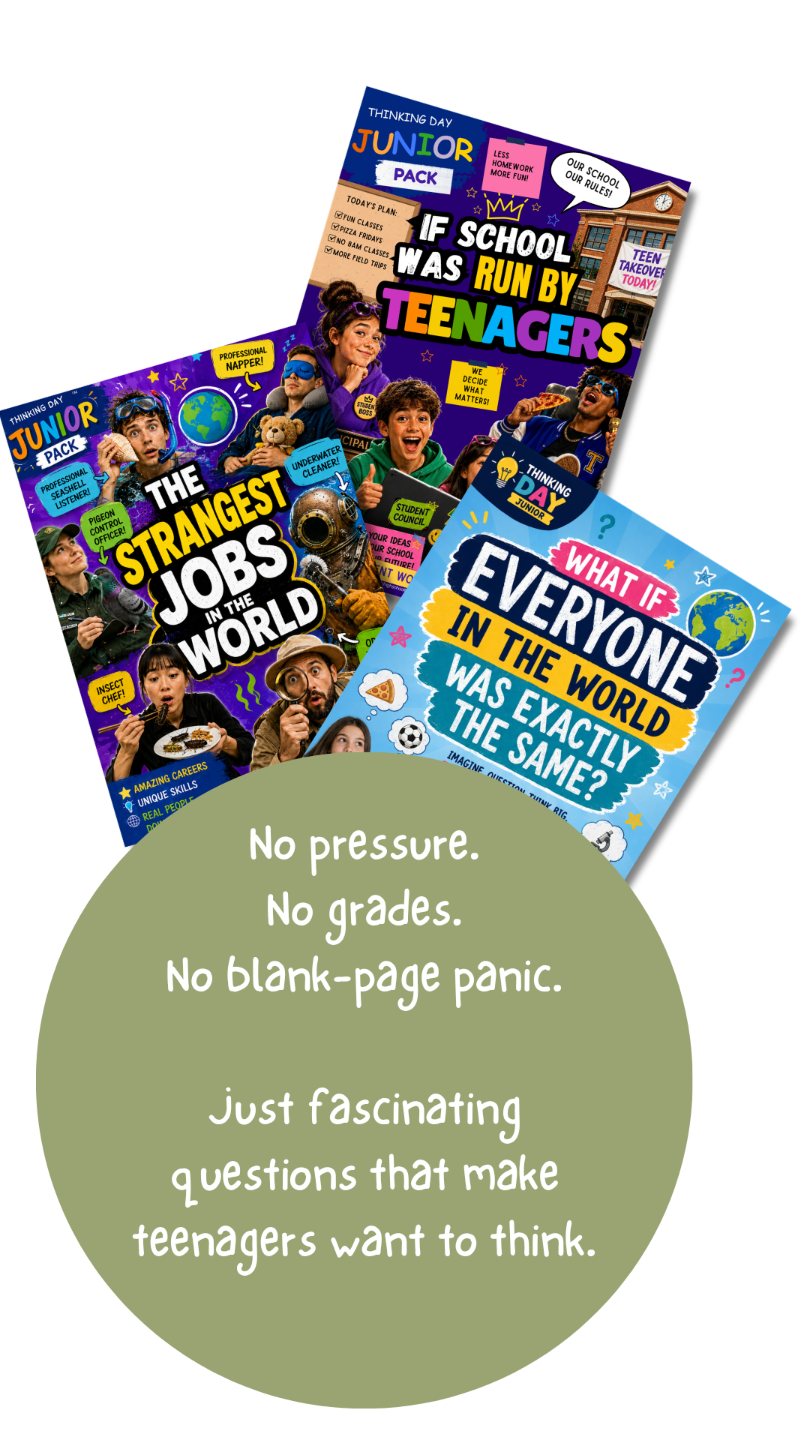
βœ“ If School Was Run By Teenagers

βœ“ The Strangest Jobs In The World

βœ“ Design Your Own Country

βœ“ Could You Survive On A Desert Island?

βœ“ If You Could Invent Anything

βœ“ The World's Weirdest Laws

βœ“ Should Homework Exist?

βœ“ What Makes A Good Friend?

βœ“ What Would Happen If Technology Disappeared?
Choose Your Membership

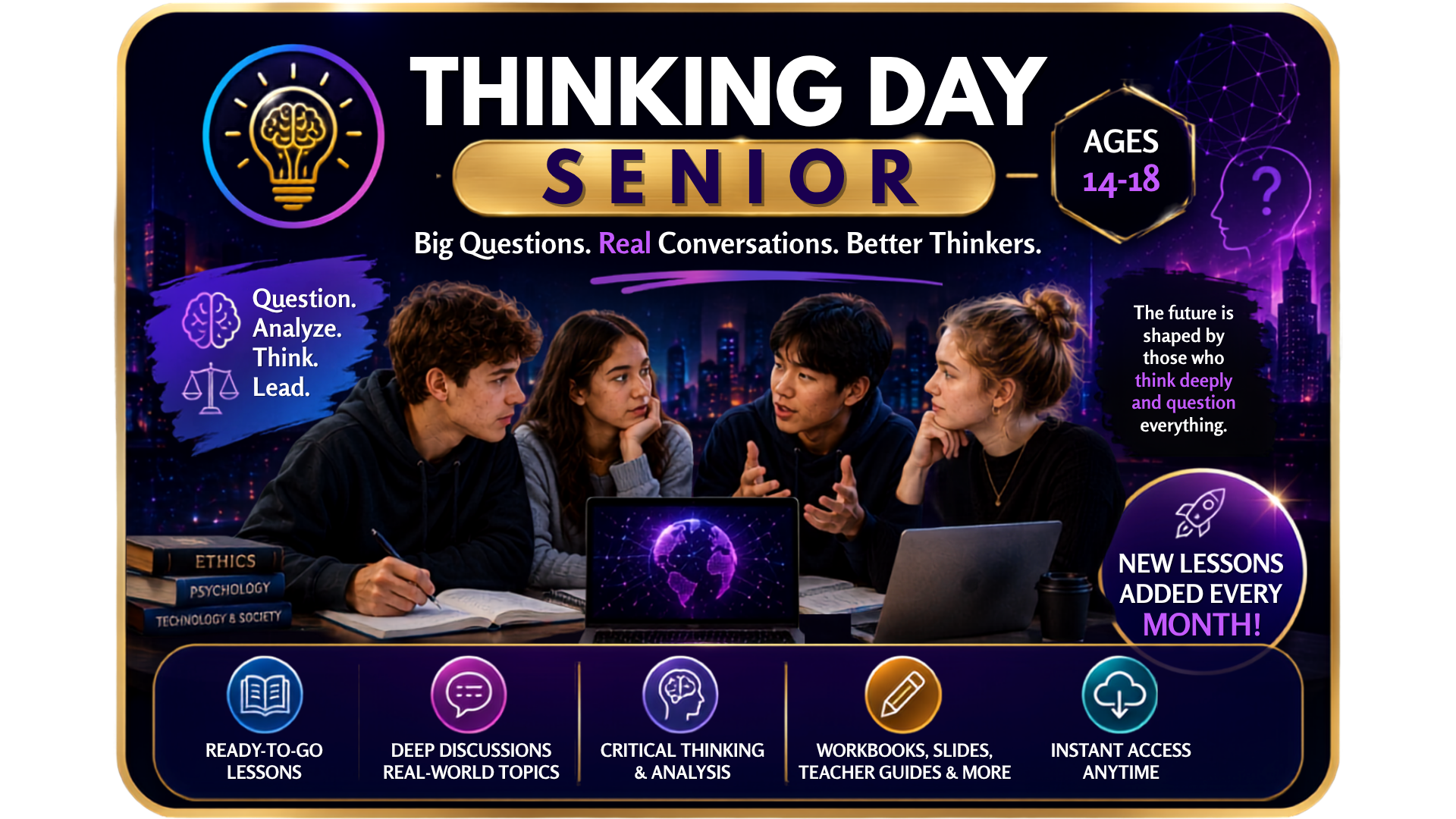
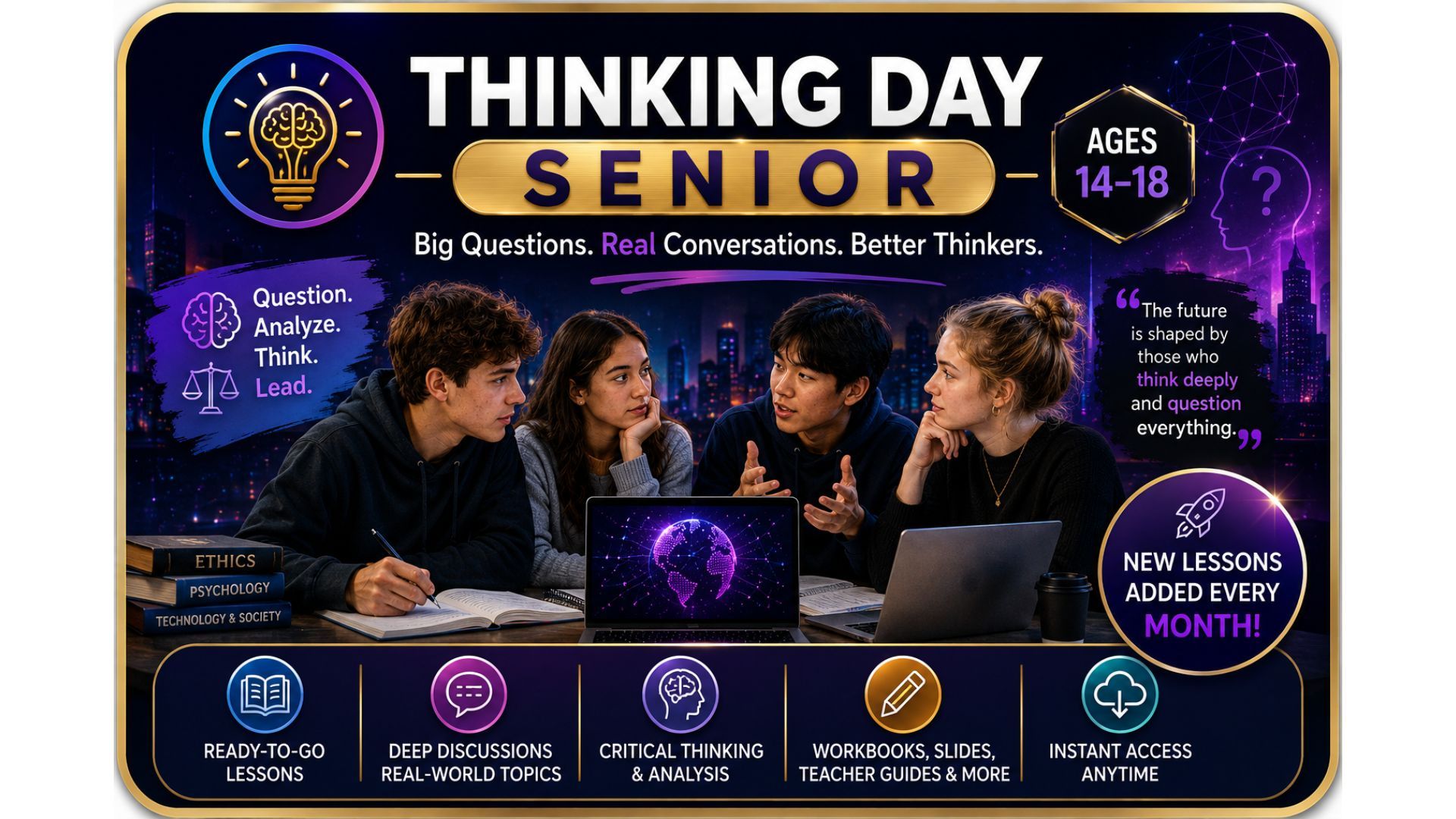
Thinking Day Senior

Ages 14-18

Thought-provoking lessons exploring real-world issues, ethics, technology, media, psychology, leadership, and the future.

Perfect for older teens ready for deeper discussion, debate, analysis, and independent thinking.

Example Topics

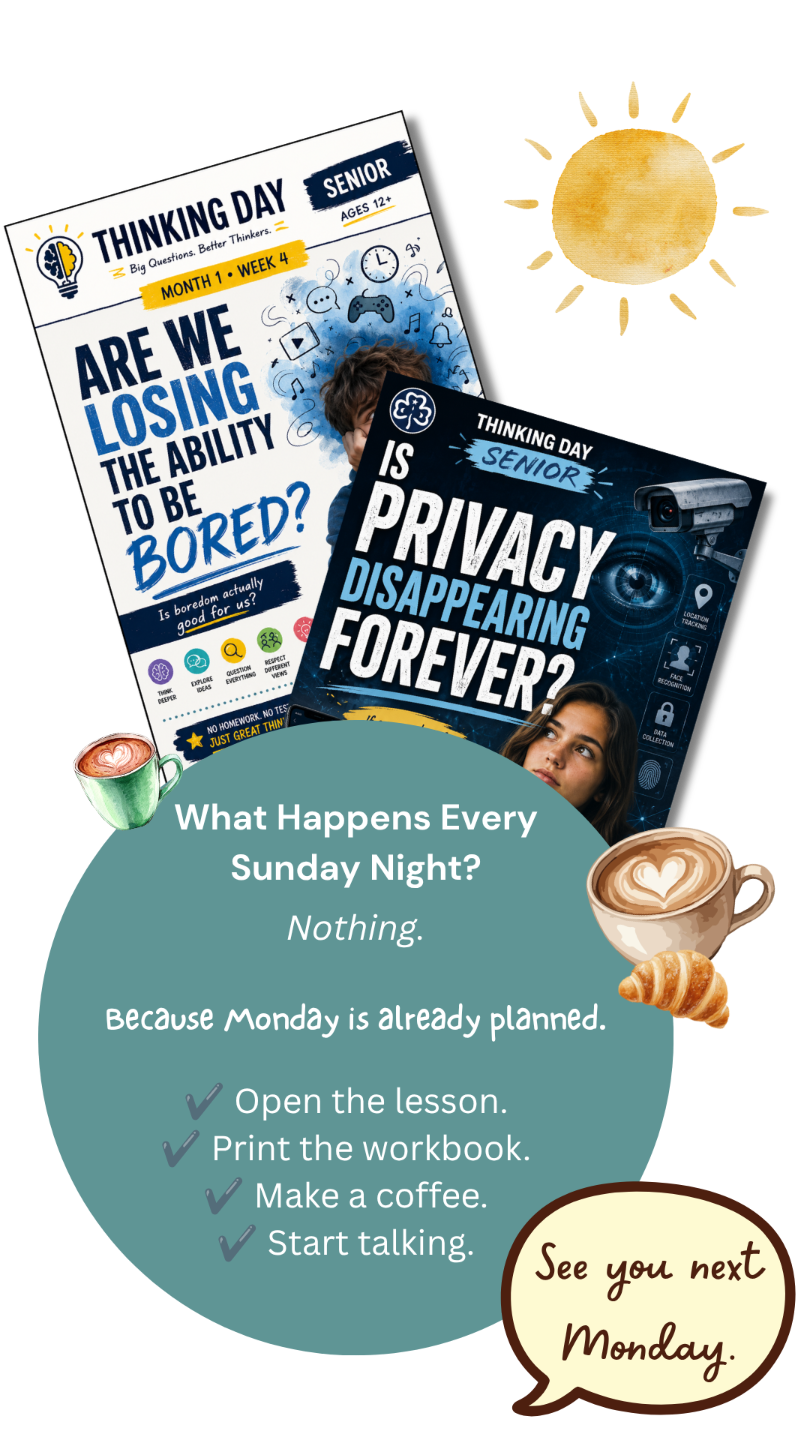
βœ“ Can AI Replace Human Creativity?

βœ“ Can We Trust Our Memories?

βœ“ The Psychology Of Social Media

βœ“ Should People Be Allowed To Say Anything Online?

βœ“ Should Robots Have Rights?

βœ“ What Makes A Good Leader?

βœ“ Is Happiness The Purpose Of Life?

βœ“ Should Influencers Have More Power Than Politicians?

βœ“ Is Privacy Dead?

βœ“ Could Humans Live On Mars?

Choose Your Membership