
ONE FASCINATING HOMESCHOOL MORNING
The Morning Basket Your Teenager Won't Outgrow
Already planned.
Ready to print.
Every Monday.
Start Our First Thinking Morning

One Fascinating Homeschool Morning Every Single Week
$24/month
No lesson planning.
No searching Pinterest.
No printing resources from six different websites.
Just open this week's Thinking Day...
...and enjoy one meaningful hour together.
✔ Four brand-new Thinking Day experiences every month
✔ Instant access to your growing lesson library
✔ Beautiful printables ready to use
✔ Cancel anytime

Imagine next Monday...
Instead of searching Pinterest...
Instead of Googling discussion questions...
Instead of wondering what today's lesson should be...
You simply...
↪ Make coffee.
↪ Print this week's lesson.
↪ Read together.
↪ Talk.
↪ Wonder.
↪ Write if you want.
Then move on with your day.
That's Thinking Day.
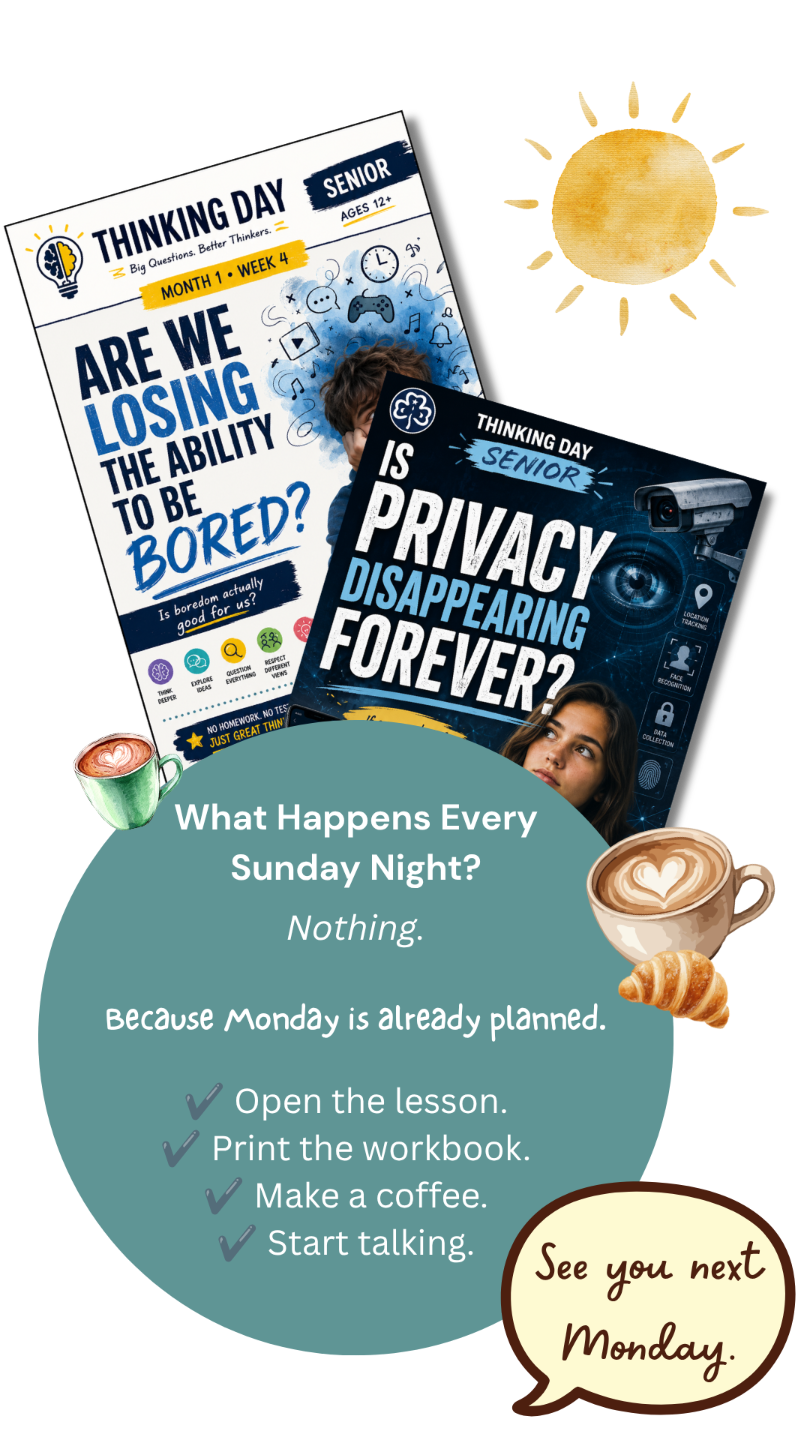
Created For Exhausted Parents Too
Open the morning basket.
Print the workbook.
Start the conversation.
We've Done Monday Morning For You.
No searching.
No lesson planning.
No printing from six different websites.
No wondering what to teach next.
Just open this week's Thinking Day and begin.
Give Me One Less Thing To Think About
Every lesson starts with
Put The Kettle On ☕
↓
Read this article.
↓
Talk about this.
↓
Complete today's challenge.
↓
Family debate.
↓
Optional Writing
↓
Done.
I'd Love This Routine

Thinking Day is the easiest way to make one homeschool morning each week genuinely interesting—without planning a thing.
Every lesson includes
🧠 One fascinating big question
📖 An engaging article
💬 Family discussion prompts
✍️ Reflection & writing activities
🎯 Curiosity challenges
🏆 Printable workbook
👨👩👧 Parent guide
I Want To Be Part Of This
Welcome To The Thinking Day Club
Every Monday morning...
families around the world are exploring the same fascinating question.
Some are debating AI.
Some are questioning history.
Some are imagining impossible inventions.
Different homes.
One shared curiosity.
"I didn't need another curriculum. I needed something that would help my son engage with learning again. Thinking Day gave us a starting point. The questions felt safe, interesting, and low pressure. It was the first time in months my son wanted to keep talking after a lesson." Amy Hicks, Parent of a Year 12 Student

Sometimes all an overwhelmed teenager needs...
...is a different place to begin.

Thinking Day Junior
Ages 11-14
Big questions designed to spark curiosity, creativity, discussion, and critical thinking.
Perfect for younger teens who are developing confidence in expressing their ideas and exploring the world around them.
Example Topics
✓ If Animals Could Speak
✓ If School Was Run By Teenagers
✓ The Strangest Jobs In The World
✓ Design Your Own Country
✓ Could You Survive On A Desert Island?
✓ If You Could Invent Anything
✓ The World's Weirdest Laws
✓ Should Homework Exist?
✓ What Makes A Good Friend?
✓ What Would Happen If Technology Disappeared?

Thinking Day Senior
Ages 14-18
Thought-provoking lessons exploring real-world issues, ethics, technology, media, psychology, leadership, and the future.
Perfect for older teens ready for deeper discussion, debate, analysis, and independent thinking.
Example Topics
✓ Can AI Replace Human Creativity?
✓ Can We Trust Our Memories?
✓ The Psychology Of Social Media
✓ Should People Be Allowed To Say Anything Online?
✓ Should Robots Have Rights?
✓ What Makes A Good Leader?
✓ Is Happiness The Purpose Of Life?
✓ Should Influencers Have More Power Than Politicians?
✓ Is Privacy Dead?
✓ Could Humans Live On Mars?
What Parents Tell Us After A Few Weeks
"My teenager started bringing ideas to dinner."
"I've stopped planning Mondays."
"They ask if the new lesson has arrived."
"This is the first subscription we've actually kept."






This Month's Conversations
This Month Inside Thinking Day Senior

This Month Inside Thinking Day Junior

What Makes Thinking Day Different?
Traditional school often asks...
"Write your answer."
Thinking Day asks...
"What do YOU think?"
Traditional lessons begin with pressure.
Thinking Day begins with curiosity.
Traditional learning rewards the right answer.
Thinking Day celebrates thoughtful questions.
My Teen Would Love TheseWhat If My Teen Refuses To Participate?
Many families join Thinking Day because traditional learning has become a battle.
Thinking Day isn't designed to force participation.
It's designed to spark curiosity.
There are no right answers, no pressure to perform, and no expectation that every discussion goes perfectly.
Start with one question and see where it leads.
"I felt like I was losing my daughter to school stress. Every conversation about learning ended in frustration, and I honestly didn't know how to help anymore. Thinking Day gave us something different to talk about. For the first time in a long time, my daughter was sharing ideas, asking questions, and engaging without feeling pressured." - Anna Smythe, Parent of a Year 10 Student



Frequently Asked Membership Questions
How often will new lessons be released?
New Thinking Day lessons are added every week, giving your teen a growing library of thought-provoking topics, debates, and critical thinking activities to explore throughout the year.
Can I cancel at any time?
Absolutely.
There are no contracts or lock-in periods. You can cancel your membership whenever you like.
What happens if I cancel?
You'll continue to have access until the end of your current billing period. After that, access to the membership library will end unless you choose to rejoin.
Do we have to complete a lesson every week?
Not at all.
Many families complete a lesson every week, while others dip into the library whenever they need a meaningful learning activity, discussion topic, or screen-free educational experience.
The membership is designed to fit around your family, not the other way around.
My teen isn't a strong writer. Will this still work?
Yes.
Thinking Day is built around ideas, discussion, and critical thinking rather than formal essay writing.
Many activities can be completed through conversation, reflection, short responses, or verbal discussion.
My teen is neurodivergent. Is this suitable?
Many neurodivergent learners thrive with Thinking Day because the lessons are discussion-rich, low-pressure, and focused on exploring ideas rather than finding the "right" answer.
Teens are encouraged to think in their own way and engage with topics at a pace that suits them.
Do I need to teach the lessons myself?
Not necessarily.
Many teenagers work through large parts of the lessons independently. Parents can be as involved as they like, whether that's facilitating discussions or simply providing the lesson and letting their teen explore it independently.
Is this only for homeschool families?
No.
While many homeschool families enjoy Thinking Day, the lessons are also popular with parents looking for meaningful screen-free activities, enrichment opportunities, or ways to encourage deeper thinking and conversation at home.
Will my teen receive certificates, grades, or assessments?
No.
Thinking Day focuses on curiosity, critical thinking, and discussion rather than formal assessment.
The goal is to help teenagers become confident thinkers, not to create more schoolwork.
Why monthly instead of individual lessons?
Because critical thinking develops over time.
One great discussion can spark curiosity.
A year of meaningful questions can help shape how a teenager thinks, communicates, and engages with the world.
Why These Skills Matter More Than Ever
Critical Thinking
Learning to question, analyse, and evaluate information.
Communication
Expressing ideas clearly and respectfully.
Perspective Taking
Understanding different viewpoints.
Independent Reasoning
Developing confidence in their own conclusions.
Curiosity
Exploring the world through questions rather than memorisation.
👉 Let's Do This



One Fascinating Homeschool Morning Every Single Week
$24/month
No lesson planning.
No searching Pinterest.
No printing resources from six different websites.
Just open this week's Thinking Day...
...and enjoy one meaningful hour together.
✔ Four brand-new Thinking Day experiences every month
✔ Instant access to your growing lesson library
✔ Beautiful printables ready to use
✔ Cancel anytime