






What You're Probably Thinking (But Rarely Say Out Loud)
Maybe you've caught yourself thinking…
💭 "Why does one paragraph take our whole evening?"
💭 "I can see they have ideas. I don't understand why writing them down is so hard."
💭 "Am I helping them learn, or just getting this assignment finished?"
💭 "I'm losing patience — and then I feel guilty about it."
💭 "What happens when the work gets harder and I can't help anymore?"
💭 "I don't want English homework to be the thing that damages our relationship."
And underneath all of that, there's a quieter thought you may not have said to anyone:
"What if we keep getting them through each assignment — and they never learn how to do it for themselves?"
Meanwhile, your teen is having their own internal conversation.
"Everyone else seems to know what to write."
"My answers are never good enough."
"I'm just bad at English."
That's the part that stings, isn't it? Not the grade. The sentence they've started saying about themselves.
And here's the thing you need to hear: this isn't your fault. You've done the hardest part already — you noticed, and you refused to ignore it. That's not failure. That's a parent paying attention.

The Hidden Culprit Nobody Has Named for You
Here's what almost every parent assumes: if we read more, practise more, work harder, it'll click.
But reading gives a teen something to think about. It doesn't teach them how to explain what they think.
The truth is, "analyse this passage" isn't one skill. It's a sequence of them:
Understand the question → form an interpretation → choose the right evidence → explain how the evidence supports the idea → organise the answer.
A teen can be strong at three of those steps and completely stuck on the fourth. And from the outside, being stuck on one step looks exactly like "not academic," "lazy," or "just not an English person."
That's why the same feedback keeps appearing.
"Develop your analysis" isn't an instruction — it's a description of what's missing. It tells them what the answer needs. It doesn't show them how to build it.
And that's why your help, as generous as it is, hasn't fixed it.
Prompting gets today's assignment finished. It doesn't give your teen the practice of doing the thinking themselves. The assignment gets finished. The skill doesn't get learned. That's the pattern.
They're not bad at English. They're missing one step — and nobody has found it yet.
JOIN THE WAITLIST
And If Nothing Changes…
Now, I'm not going to tell you your teen is doomed. That's not how this works, and you'd rightly stop reading.
But I will tell you what usually happens when a specific skill gap goes unnamed — because it doesn't stay the same size.
Think of it like a nail in a floorboard.
It's uncomfortable now, but not quite uncomfortable enough to move. So you shift your weight, you work around it, you keep going. The problem is that the nail doesn't go away. The floor just gets harder to walk on.
Here's what that looks like in real terms:
Tonight: One hard assignment a week. A parent who can still step in and rescue the paragraph.
In two years: Senior English. Longer responses, higher stakes, less scaffolding, and a teacher with thirty other students. You won't be sitting beside them in the exam room, and neither will I.
In four years: Subject choices, prerequisites, and results that follow them out of school — quietly narrowing doors they don't even know they want open yet.
And in the meantime, the smaller costs add up:
→ Time: Another year of evenings disappearing into one paragraph.
→ Confidence: "I'm bad at English" hardening into something they believe about themselves as a person, not just as a student.
→ Relationship: English staying the thing you argue about, instead of the thing you talk about.
→ Money: More resources, more tutoring, more support that re-teaches the book instead of teaching the missing step.
→ Independence: You, still sitting beside them at 15, wondering how you'll ever step back.
The gap doesn't close on its own. It just gets more expensive to close.
These are the patterns that tend to happen when a skill gap goes unaddressed — not a prediction, and not a claim that this programme is the only way forward. But it is what I'd want to know if it were my child.
But Here's the Good News
This isn't a talent problem. It's a findable problem.
A written response is a sequence of teachable moves. When someone sits down and identifies exactly which step your teen is stuck on — and then teaches that step, demonstrates it, and gives them practice with real feedback — the blank page stops being a mystery.
And something else happens too.
When the work finally sits at the level they can actually succeed at, the resistance fades. Teens don't resist English. They resist feeling stupid. Fix the second thing and the first one tends to disappear.
Which means you get to do something you've been waiting a long time for:
step back, and be their parent again.
In the next section, I'll show you exactly how that works — and what it looks like inside the CHST English Lab.
JOIN THE WAITLIST
Think About How You Learned to Drive
You didn't learn by watching someone else drive. You didn't learn by memorising the road rules until you could recite them. And you certainly didn't learn by having a parent in the passenger seat grab the wheel every time you hesitated at a junction.
You learned because someone sat beside you, showed you what to do, let you try it badly, told you exactly what to fix, and then let you try again — while they were still there to catch it.
That's the part almost every teen is missing with English.
Right now, your teen gets the demonstration. A teacher explains what the book means. And they get the verdict — feedback on the finished answer, three days later, when the moment has already passed.
What they don't get is the middle.
The part where they attempt it themselves, get stuck, and have someone help them at the exact point of stuckness.
That's not a gap in your teen's effort. It's a gap in the structure of how they're being taught.

The CHST Guided English Method:
Learn → Practise → Improve
This is the vehicle. Not a workbook, not a revision guide, not another round of "just read more." A three-part teaching cycle, delivered live, in a group of no more than four students.
Each week, your teen works on one main English skill across three connected sessions:
Learn. The tutor explains the skill in plain language and models the thinking behind a strong answer — out loud, step by step, so your teen can see how an interpretation is actually built rather than just what a finished one looks like.
Practise. Your teen applies it while the tutor watches, checks their understanding, and identifies precisely where they get stuck. Not "needs to develop analysis." The actual step: this is the part you can't do yet.
Improve. Your teen receives one specific next step, revises their work, and then tries the same skill on a fresh example — while the tutor is still in the room.
The complete teaching-and-feedback cycle happens inside the sessions.
Your teen doesn't attempt the work alone at home and wait days to find out what went wrong. They attempt it, get help at the sticking point, and act on the feedback immediately, with support right there.
Across two terms, this builds deliberately:
From explaining an idea in a single paragraph, to writing complete responses, to comparing perspectives and applying skills with far greater independence.
Want to understand the research informing this approach? Download “Why We Teach This Way”.The Cold, Hard Truth
Here it is, and I'd rather say it plainly than dress it up:
You cannot prompt a skill into a person. You can only teach it, watch them try it, and correct it while you're still in the room.
That's the whole thing. Everything you've been doing at the kitchen table has been generous, patient and well-intentioned — and it has been doing the thinking your teen can't yet do alone. Which is exactly why the same feedback keeps coming back.
If your teen could learn this by being helped to finish, they would have learned it years ago.
JOIN THE WAITLIST
Why This Works When Everything Else Hasn't
Here's the mechanism, and once you see it you can't unsee it.
Take the five-step sequence from earlier — understand the question, form an interpretation, choose evidence, explain how the evidence supports the idea, organise the answer.
A teen can be strong at four of those steps and completely stuck on the fifth.
And from the outside, being stuck on one step looks identical to "not academic," "lazy," or "just not an English person."
Here's what that looks like in practice.
A student writes:
"Maya hides her certificate in her bag. This means she puts it away."
They've repeated the action. That's the sticking point — and it's invisible unless someone is watching for it. So the tutor asks one question: "What might hiding an achievement suggest about how she feels about sharing it?"
The student revises:
"Maya hides her certificate, suggesting she is reluctant to draw attention to her achievement."
Then the tutor checks whether they can make that same connection in a passage they've never seen before.
That's the difference between a corrected sentence and a learned skill.
Now compare that to the three things you've already tried:
More reading gives your teen something to think about. It doesn't teach them how to explain what they think.
Homework help gets the assignment finished. It doesn't transfer the thinking to your teen — which is why the struggle returns with the next question.
Content tutoring re-teaches the book. If the tutor is explaining what the chapter means rather than teaching the missing step, the same comments were always going to come back. "Develop your analysis" isn't an instruction. It's a description of what's missing. It tells a student what the answer needs. It doesn't show them how to build it.
And this is the part that matters most to you, isn't it?
Not the paragraph. The sentence your teen has started saying about themselves. When the work finally sits at the level they can actually succeed at, "I'm bad at English" can become "I know which part I need help with, and I have a way to practise it."
That's not a confidence trick. That's what happens when someone finally names the step.

"But What About…"
Let me take the obvious doubts head-on, because you're entitled to honest answers.
"They already get English lessons at school." They do — and school does the diagnosing well. What school rarely has is the time to sit with one student and teach the specific missing step. Thirty other students, one teacher, one lesson. The gap gets identified. It rarely gets taught.
"We've tried tutoring before and it didn't help." Then it's worth asking what that tutoring was actually teaching — the content of the book, or the skill your teen was missing? If it was content, the same feedback was always going to return. That's not a failure of tutoring. It's a mismatch of target.
"They just need help finishing their homework." Immediate help is genuinely useful, and I'm not dismissing it. But if the goal is a teen who can eventually do this without you, then finishing the assignment is the short game. Building the skill is the long one.
"Three sessions a week is a lot." It is, and I won't pretend otherwise. It's a real commitment, and only you can judge whether it fits your family's week. What I'd ask you to weigh it against is this: you're already spending hours on English — prompting, re-explaining, sitting beside them, absorbing the tension. This replaces that time rather than adding to it. But it's your call, and you should make it with your eyes open.
JOIN THE WAITLIST
INTRODUCING ...
The Classic High School
English Lab

The Classic High School English Lab isn't just another English tutor —
It's the step-by-step pathway that takes your teen from "I don't know what to write" to explaining an idea in writing, on their own.
The CHST English Lab is a live, small-group English tutoring programme for teens aged 13–15 — three 60-minute sessions a week for ten weeks, in groups of no more than four — designed to close the gap between reading a text and writing a clear, analytical answer about it.
Your teen doesn't need more worksheets, more texts, or another adult telling them to "add more detail." They need the thinking behind an answer made visible, then time to practise it with a tutor watching — and that's exactly what happens inside the Lab.
The Lab helps your teenager learn to turn up, think, write, revise and become more independent—with a tutor who knows them and follows through.
JOIN THE WAITLISTHere's what's waiting for your teen inside:
✅ 30 LIVE Sessions Per Term — Learn → Practise → Improve
Ten explicit teaching sessions, ten guided practice sessions and ten feedback-and-revision sessions, so your teen doesn't just hear the method, they use it, get corrected and improve their work while the tutor is still in the room.
✅ Groups of No More Than FOUR Students
The single most important number on this page. Small enough that every student's ideas get heard, every quotation choice gets checked and every paragraph gets inspected — no hiding at the back of a class of thirty.
✅ The CHST Guided English Method
A predictable, repeatable routine that makes the invisible thinking behind a good answer visible: understand the question → build an interpretation → choose evidence → explain it → write the paragraph. No more staring at a blank page waiting for you to supply the first sentence.
✅ Eliminate the Guesswork From Every Step
Your teen will know exactly what to do after they've picked a quotation — the part where most students stall — and will practise revising their own paragraph instead of waiting for someone to rewrite it for them.
✅ Visible Progress You Can Actually See
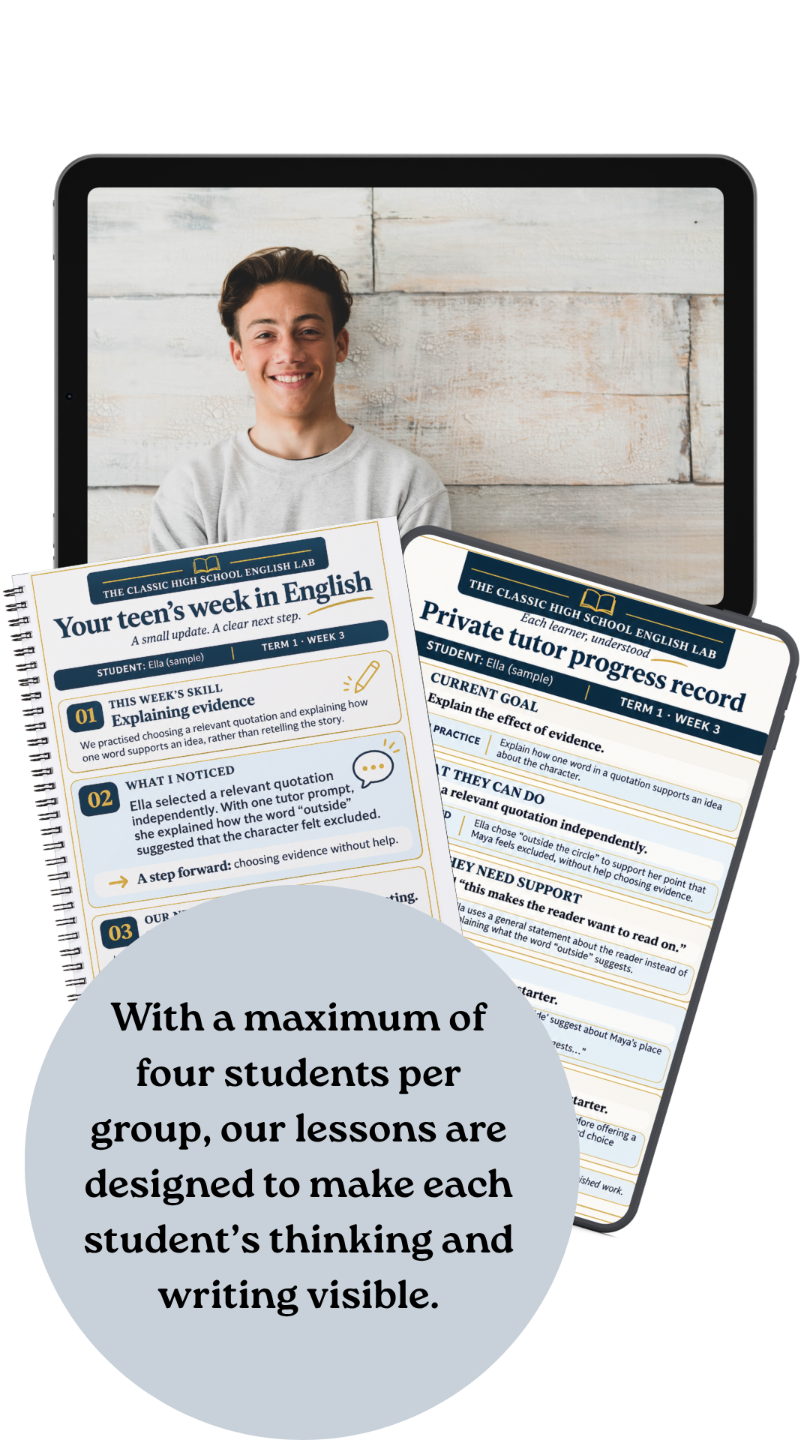
A writing portfolio of first attempts, revisions and a final task, plus individual progress records and weekly parent updates, so you're never guessing whether it's working or wondering what to do next.
✅ A Clear Three-Term Pathway to Independence
Term one builds structured analytical paragraphs. Later terms connect those paragraphs into complete responses, comparison and argument — with your teen needing less prompting from you at every stage.
🎁 PLUS: Ten Weekly Catch-Up Lessons — Included at No Additional Cost (US$500 Value Per Term)
A short prerecorded recap for every teaching week, with a worked example and a practice activity, so a missed session never becomes a missed skill — or another evening of you reconstructing a lesson you never heard.
This isn't a course your teen watches. It's a room of four where their thinking gets heard, their writing gets read, and their next step gets named — week after week, until they can do it without you.
Join the Waitlist → Only four students per group.Let Me Show You What's Waiting Inside…
Three ten-week terms. One clear path. Each term builds on the last — so your teen isn't starting over every time, and you're not re-explaining the same thing every afternoon.
Families enrol one term at a time. You start with Term 1, and decide about Term 2 at the end of it.
Choose the group that fits your week
Each group meets Monday, Wednesday and Thursday, at the same time each day. Your teen attends all three weekly sessions with their group.
There are four places per group, with only 24 places available across our first intake. Priority goes to waitlist members first.

Monday, Wednesday & Thursday
4:00–5:00 pm Eastern Time

Monday, Wednesday & Thursday
5:30–6:30 pm Eastern Time

Monday, Wednesday & Thursday
4:00–5:00 pm Pacific Time

Monday, Wednesday & Thursday
5:30–6:30 pm Pacific Time

Mon/Wed/Thu,
4–5 pm Sydney/Melbourne time

Mon/Wed/Thu,
5:30–6:30 pm Sydney/Melbourne time
Join the waitlist to receive the booking link when enrolment opens. You’ll be able to select an available group, subject to suitability for your teen’s learning level. Each group closes once its four places are filled.
Joining the waitlist does not reserve a place.
Your preferred time not listed above? When you join the waitlist, please let us know - more times will be confirmed shortly.
JOIN THE WAITLIST
How we teach:
Learn → Practise → Improve
Understanding an explanation is the beginning. Your teen also needs opportunities to try it, receive feedback and use the skill again.
Learn: Their tutor models the skill and explains the thinking behind a response.
Practise: Your teen applies it, with guidance available when they get stuck.
Improve: They use individual feedback to revise, then try a fresh example so their tutor can check what they can do with less help.
Want to understand the research informing this approach? Download “Why We Teach This Way”.
STAGE 1 · TEN TEACHING WEEKS
From “I’ve read it, but I don’t know what to write” to a clear, supported paragraph
Help your teen turn what they understand into something they can put on the page.
You’ve heard them explain the chapter at dinner. Then they sit down to answer the question—and suddenly they have nothing to say.
Sometimes they don’t understand what the question wants. Sometimes they can find a quotation but can only repeat what it says. Sometimes they have an idea but don’t know how to build it into a response.
We start by finding that missing step.
Through our Learn → Practise → Improve rhythm, your teen sees the skill modelled, tries it with guidance and uses feedback to improve their own writing. With just four students in each group, the tutor can look at their actual work and check where they need help.
DURING STAGE 1 YOUR TEEN WILL PRACTISE:
-
Working out what the question is asking, so they have a clear starting point.
-
Making a supported inference, explaining what a passage suggests without guessing beyond the evidence.
-
Choosing a relevant quotation, rather than adding one because they know they’re supposed to.
-
Explaining a word, image or technique, moving beyond naming it to discussing what it contributes.
-
Building a clear analytical paragraph, connecting their answer, evidence and explanation.
-
Using feedback to revise, then trying the same skill with a fresh passage.
What progress are we working towards?
A paragraph that answers the question, uses relevant evidence and explains an idea beyond the events of the story—with less help than your teen needed at the start.
You’ll receive brief weekly updates, a midpoint review and an end-of-term report with writing samples, a skills snapshot and recommended next steps. We record the support needed as well as the quality of the finished writing, so you can see what your teen is beginning to do independently.
Explore the first intake
STAGE 2 · TEN TEACHING WEEKS
From one clear paragraph to a connected, convincing response
Help your teen develop an answer—and keep their thinking going beyond the first paragraph.
One good paragraph is a useful beginning. The next challenge is deciding what comes after it.
Your teen might repeat the same point, collect quotations without connecting them or start writing before they know what they want to argue.
Stage 2 builds on the foundations of Stage 1. Students practise planning a response, developing related points and using evidence to support a clear interpretation.
The weekly rhythm stays familiar: Learn → Practise → Improve, with three live sessions, a group of four and individual feedback. Support is adjusted as students become ready to make more decisions for themselves.

DURING STAGE 2 YOUR TEEN WILL PRACTISE:
-
Planning before writing, choosing a central answer and the points that will support it.
-
Connecting two or more paragraphs, so each one develops the response rather than repeats it.
-
Developing an interpretation, explaining what they think a text suggests and why.
-
Checking their ideas against the evidence, refining an explanation when the passage doesn’t fully support it.
-
Revising the whole response, looking at the order of ideas as well as individual sentences.
-
Applying their skills to unfamiliar passages, with gradually reduced prompting and manageable timed practice when appropriate.
For students ready for a further challenge, we introduce comparing how two short texts approach a similar idea.
What progress are we working towards?
A connected analytical response with a clear central idea, relevant evidence and explanations that build across paragraphs—with increasing independence in planning, writing and revision.
Your end-of-term report will show the progress made, the support still needed and recommendations for continued development.
Join for one term. Build from there.
Each stage is a separately booked ten-week teaching programme. Your initial booking covers one stage, with the option to continue into the next.
We use a starting writing sample to help identify a suitable group and learning focus. Progress varies, and tutors adjust the support and challenge to suit the students in their group.
An optional summer programme may be offered separately. It is not required to complete either stage.
Want a closer look at what we’ll teach?
Explore our two-stage curriculum, including the weekly learning focuses, examples of what students will practise and how we’ll track their progress.
Download the Parent Curriculum Guide
Download Curriculum
Each term is enrolled separately. Places in Term 1 are limited to four students per group — which is why the waitlist opens first.
The intake for January 2027 opens on December 6th, 2026.
2027 Teaching Dates
January intake: 25 January–15 April 2027
Ten teaching weeks, with three live sessions each week.
Planned breaks — no live sessions:
-
15–21 February
-
22–28 March
For Monday/Wednesday/Thursday groups, the first session is 25 January and the final session is 15 April.
September intake: September–November 2027
Our second intake is planned for September. Exact teaching dates and breaks will be published before enrolment opens.
You book one stage at a time. Your January enrolment does not commit you to the September intake.
Can my teen join in September if they didn’t attend in January?
Yes! We welcome new students at both intakes. Your teen’s starting writing sample helps us identify a suitable stage and group.
Students usually begin with Stage 1, while returning students can continue into Stage 2 when ready. You don’t need to have enrolled in January to join us in September.
All groups follow the teaching dates and breaks listed above. Session days and times follow your selected group’s advertised local time zone.

Wait — Before You Join the Waitlist, There's Something Else I Want to Put in Your Hands
Here's the thing nobody warns you about when you finally get your teen the right help: life still happens.
They get sick. There's a school camp. A family thing. A week where the English folder stays shut because the week got away from you. And that familiar knot comes back — "Now they've missed something. Now they'll be behind. Now I'll have to work out what they missed and teach it to them myself."
That's exactly the gap this bonus closes.
You'll receive US$550 worth of additional support per term when you join — included at no additional charge, so a missed session never turns into a missed skill (or another evening of you trying to reconstruct a lesson you never heard).
BONUS
Missed a Session Doesn't Have to Mean Falling Behind — Here's Your Safety Net (US$550 Value Per Term)
You know that sinking feeling when your teen misses a lesson and you think, "Right, so what do I do now?"
You're not alone — and you shouldn't have to become the substitute teacher. The CHST Weekly Catch-Up Library is ten short, prerecorded lessons per term: one focused recap for every teaching week, so your teen can review the exact skill that was taught, watch the tutor work through it, and practise it themselves before returning to the group.
Think of it as a rewind button for the whole term. Missed Tuesday? They watch the recap, do the short practice, and walk back into the next session knowing what's going on. And if they were there but didn't quite get it — or froze the moment they sat down to write — they can pause, replay and hear the explanation again, at their own pace, without anyone watching over their shoulder.
✅ Ten lessons per term – One focused recap for each teaching week, so nothing gets left behind.
✅ Plain-language teaching – The week's main skill explained concisely, the way your teen can actually absorb it.
✅ A worked example – The tutor demonstrates the process and explains their thinking out loud — the "how," not just the "what."
✅ A short practice activity + model response – Your teen applies the teaching, then checks their approach against a model to see what to improve.
✅ Pause-and-replay flexibility – Review at their own pace, as many times as they need, without asking you to re-explain it.
✅ Clear preparation for the next session – They know exactly what to understand or complete before returning to the group.
JOIN THE WAITLIST

To be clear about what this is and isn't: the Catch-Up Library supports continuity. It doesn't replace the individual feedback, discussion and guided practice your teen gets in live sessions — it protects it. It's the difference between "we missed a week and lost ground" and "we missed a week, caught up in twenty minutes, and carried on."
One Last Thing — Don't Leave This Behind
The Catch-Up Library is part of the term enrolment, not a separate purchase — and it can't be added afterwards. You can't buy it on its own, and it isn't offered outside enrolment.
Total Bonus Value: US$550 per term — Yours With Your Seat.
Because here's what I don't want for you: a term where one missed session quietly becomes the week your teen stops following along, starts avoiding the work again, and you're back at the kitchen table at 8pm trying to work out which step they lost.
Join the waitlist today, and the safety net is already in place — before you need it.
JOIN THE WAITLISTProof, Not Promises: What the Feedback Actually Looks Like
You've heard how it's meant to work. Here's the same student, same passage, over three sessions — because the method is only worth anything if you can see the difference between a corrected sentence and a learned skill.
Every student leaves with a portfolio — first attempts, revisions and a final task — plus individual progress records, because you shouldn't have to take my word for it. You'll be able to see the work move.
JOIN THE WAITLIST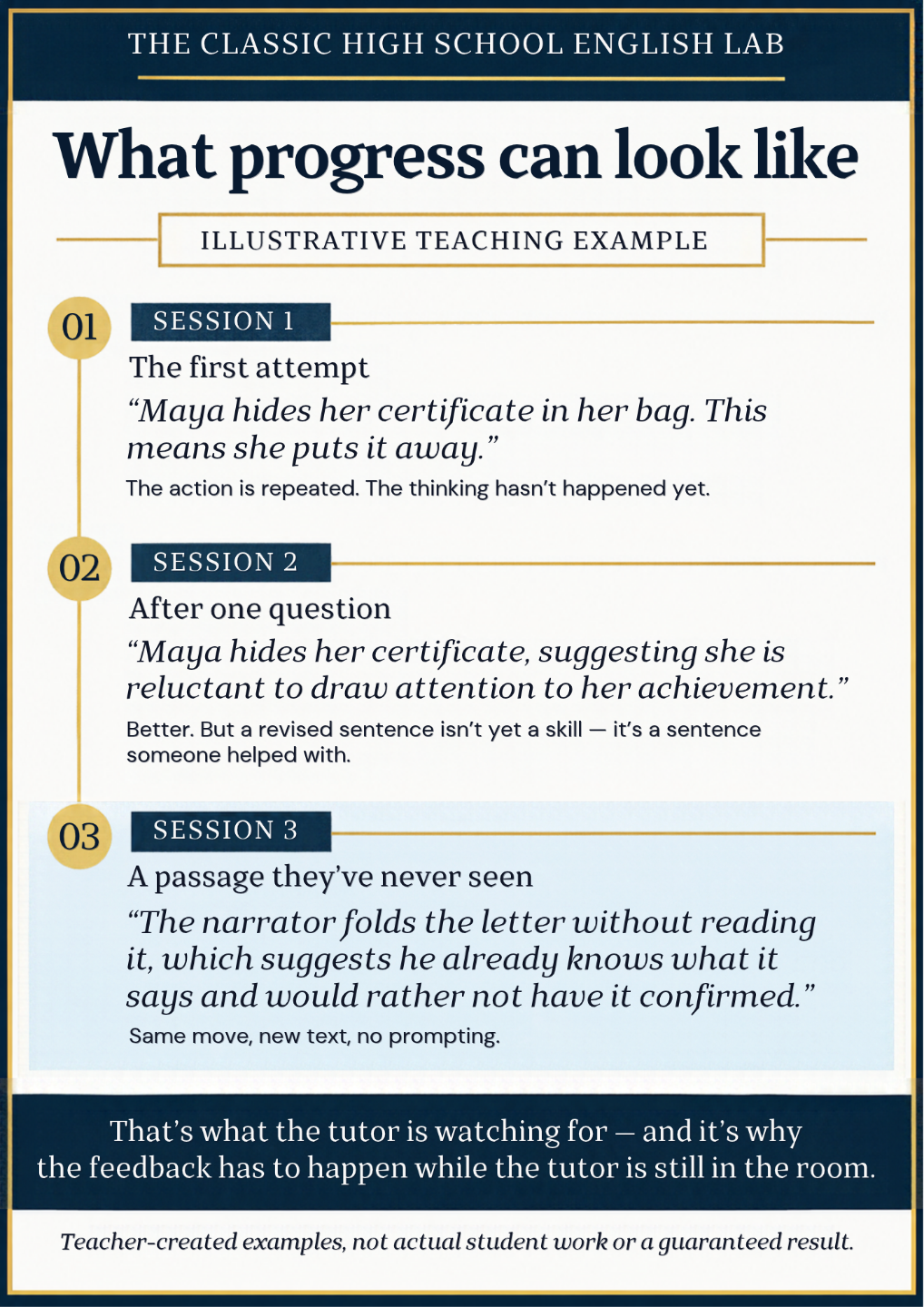

At this point, you're probably thinking, "Okay, okay… just tell me the number."
I get it. You've read this far. You can picture what you want for your teen. And now you want to know what it takes to get there.
But before I give you the number, I want to talk about how I arrived at it — because there's a decision hiding underneath the number, and I don't want you to make it by accident.
Here's what I mean. Most of us are trained to look at a figure and ask one question: "Can I afford this?"
That question feels responsible. It feels like good parenting. But it's actually the wrong question — because it only looks at one side of the ledger.
The better question is: "What does it cost me to keep things exactly as they are?"
So let's look at both sides. Then you can decide with your eyes open.
Think about the last big decision you made for your family. Maybe it was the house you live in now.
You didn't choose it because it was the cheapest option on the list. If price were the only thing that mattered, you'd have picked the smallest place in the least convenient street and been done with it.
You chose it because of what life inside it would feel like. The space. The street. The school down the road. The feeling of your kid doing homework at the kitchen table and actually getting somewhere.
When something is important enough, the number stops being the whole conversation. It becomes one factor among many.
And I'd argue there is nothing more important than your teen learning how to think and write for themselves — because that skill follows them into every subject, every exam, and eventually every job.
So let me be straight with you about what this is. This is not a US$49-a-month worksheet subscription. It's not a video library you'll forget the login for. It's not a "just get the assignment done" service that leaves your teen exactly where they started next term.
This is 30 live sessions with a real teacher, in a group of no more than four students, where your teen practises the actual thinking behind a written answer — and gets feedback on their own work.
That's a different category of thing. And it's built to produce a different category of result.
JOIN THE WAITLISTHere's exactly how the number was built. No mystery, no markup for the sake of it.
The programme runs 30 live, 60-minute sessions across a ten-week term, at US $55 per student, persession. That comes to US1,650 per term.
That US$55 buys more than an hour of talking. It covers:
- Explicit teaching — the tutor showing your teen how to unpack a question, form an interpretation, and choose evidence that actually fits.
- Supervised writing practice — your teen writing in the session, not just listening. This is where the skill sticks.
- Feedback on their own work — specific, on their sentences, so they know what to fix and why.
- A group of no more than four — small enough that nobody hides at the back.
- Learning materials and progress updates — so you can see movement without having to interrogate anyone at dinner.
- Ten prerecorded catch-up lessons — so a missed session or a busy week doesn't break the rhythm.
And behind the sessions sits the work you don't see: curriculum development, tutor training, and ongoing supervision to make sure the teaching is consistent from week to week.
So when you look at US$1,650, you're not looking at a fee for babysitting with a whiteboard. You're looking at 30 hours of structured, supervised, feedback-driven teaching — plus the planning and quality control that make those 30 hours worth showing up for.

Now let's compare this to the obvious alternative: private one-to-one English tutoring.
One US provider lists general English tutoring at US120 per hour — or US1,100 for a ten-hour block.
Run that out to 30 hours and you're at US$3,300.
Thirty hours of private tutoring: US$3,300. Thirty small-group sessions in the CHST English Lab: US$1,650.
That's US$55 a session agains tUS $110–120 an hour. And to be fair, the formats aren't identical. Private tutoring gives your teen exclusive individual attention; the Lab shares teaching time across four students.
So here's the honest trade. If your teen needs one-to-one attention, or specialist intervention, private tutoring may genuinely be the right call — and I'd rather you made that choice than spent a term hoping.
But if what your teen needs is to be taught the missing step, watched while they practise it, and corrected while the tutor is still in the room — the Lab does that for roughly half the hourly cost, and adds something private tutoring rarely gives a teenager: three other students whose thinking they can hear and learn from.
US1,500 for the term (there's a discount if you pay in full). Or three instalments of US550. One term at a time.
JOIN THE WAITLIST
The Classic High School English Lab
Here's everything you get when you enrol your teen in the CHST English Lab — one term, one clear path, and all of it laid out on one page.
Here's What's Waiting Inside Your Ten-Week Term
✅ 10 LIVE "Learn" Sessions —
Explicit teaching, teacher demonstrations and worked examples that make the thinking behind a strong answer visible, so your teen stops staring at a blank page waiting for the first sentence. (Value: US$600)
✅ 10 LIVE "Practise" Sessions —
Guided reading and writing with the tutor watching, checking understanding and naming the exact step your teen gets stuck on — not "develop your analysis," but this is the part you can't do yet. (Value: US$600)
✅ 10 LIVE "Improve" Sessions —
Actionable feedback, supported revision and a fresh example, so your teen revises their own paragraph instead of waiting for someone to rewrite it for them. (Value: US$600)
✅ The Complete CHST Guided English Method (Learn → Practise → Improve) —
The full cycle from "I don't know what to write" to a structured analytical paragraph with a clear idea, real evidence and an explanation that goes beyond retelling the story. (Included)
✅ A Group of No More Than FOUR Students —
Small enough that every idea is heard, every quotation choice is checked and every paragraph is inspected. No hiding at the back of a class of thirty. (Included)
✅ Weekly Learning Materials, Initial Placement Task, Individual Progress Records, Parent Progress Updates and a Student Writing Portfolio —
So you can finally see where your teen is developing and what still needs support — with evidence, not guesswork, and less prompting from you every week. (Included)
✅ The Three-Term Pathway to Independence —
Term one builds structured analytical paragraphs. Later terms connect them into complete responses, comparison and argument — with your teen needing less prompting at every stage. (Included)
That's 30 live, 60-minute sessions — three a week for ten weeks — with teaching, practice and feedback built into every single one.
PLUS, You're Getting This Bonus Included:
🎁 CHST Weekly Catch-Up Library — 10 Short Prerecorded Lessons (One Per Teaching Week) —
A focused recap of each week's skill with a worked example, a short practice activity and a model response, so a missed session never becomes a missed skill — or another evening of you reconstructing a lesson you never heard. (Value: US$500 per term)
Here's the Part Where It All Adds Up
The value of the live sessions is US1,650. The Catch-Up Library adds US500 on top — a total package value of US$2,150.
You pay US$1,500 if you pay in full. Which means everything outside the live teaching — the materials, the placement task, the progress records, the parent updates, the portfolio and the ten catch-up lessons — comes at no additional cost.
You can start for US$550 today — your first of three instalments — or pay US$1,500 in full for the ten-week term. One term at a time, no long-term lock-in, no hidden extras.
And remember why there's no refund clause: every seat is a place another teen could have taken.
This is built for families who are ready to show up to all 30 sessions, engage with the feedback and do the work — alongside three other students doing exactly the same.
(Scholarships are available by application if cost is the barrier — one full scholarship, and partial scholarships of US500 reducing the term fee to US1,000. If you're committed but money is tight, apply — don't walk away.)
So What Are You Waiting For?
Join the waitlist below — one term, thirty sessions, and a clear process they'll keep using long after the ten weeks are over.
Join the Waitlist →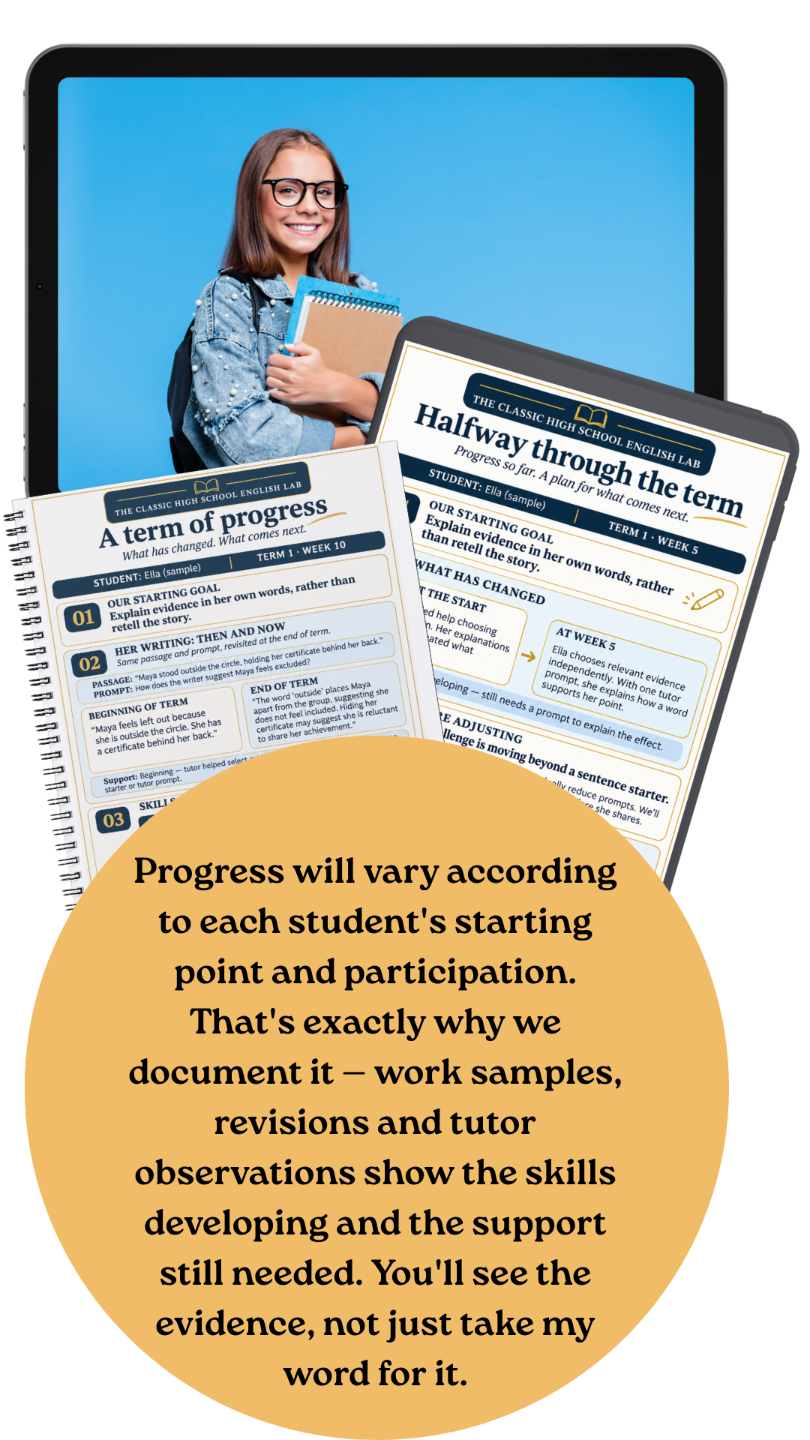
The Fairness Summary
Here's what makes this fair on both sides:
You are not locked into anything long-term. Families enrol one term at a time. You commit to ten weeks — not a year, not a monthly membership you have to remember to cancel. At the end of the term, you decide whether to continue.
You know the price before you start.
US1,500 per term, ,or three instalments of US550.
No hidden extras, no surprise upsells.
You know what's included before you start.
Thirty live sessions, materials, feedback, progress records and the catch-up lessons — all listed above.
And if cost is the barrier, there is another route. Limited scholarships are available by application: one full scholarship, and a partial scholarship of US500, reducing the term fee to US1,000 for recipients. If you're committed but money is tight, apply — don't walk away.
This Is for Families Who Are Ready — No Refunds, No Exceptions
You might be wondering, "What if this doesn't work for my teen?" I completely understand — US$1,500 is a real investment, and you want to know it's going somewhere worthwhile.
But here's the thing: I only want to work with families who are all in.
The CHST English Lab runs in groups of no more than four students.
Every seat is a place another teen could have taken. When a family joins half-heartedly and leaves partway through, it doesn't just affect them — it changes the group dynamic for the three other students who showed up ready to work.
That's why there is no refund. Not because I'm hiding something, but because this programme is built for action-takers, not spectators.
I'm confident that if your teen attends the 30 live sessions, engages with the feedback and does the work, you will see a real shift — from "I don't know what to write" to having a clear process for understanding a text and explaining an idea in writing. That's what the explicit teaching, guided practice and feedback in every session are designed to produce.
But if you're looking for a safety net before your teen has even logged into their first session, then this probably isn't the right fit — and that's completely okay.
I want your teen fully committed to their progress, just as I am.
What You're Actually Committing To
This isn't a vague promise — here's exactly what your US$1,500 covers each term:
- 10 live Learn sessions — explicit teaching, teacher demonstrations and worked examples (US$550 value)
- 10 live Practise sessions — guided reading and writing with the tutor checking understanding (US$550 value)
- 10 live Improve sessions — actionable feedback, supported revision and fresh examples (US$550 value)
- Weekly learning materials, initial placement task, individual progress records, parent progress updates and a student writing portfolio — all included
- Bonus: 10 weekly prerecorded English Catch-Up Lessons — included at no additional charge (US$500 value)
That's 30 live, 60-minute sessions — three sessions a week for ten weeks — with a maximum of four students per group. Teaching, practice and feedback are built into every session.
Pay in full: US1,500. Or three instalments of US550.

Before You Join — A Quick Check
This programme is right for you if:
- Your teen can retell a story but freezes when asked what it means
- You're willing to have them attend all 30 live sessions and engage with feedback
- You want them to build independence, not have a parent supply every sentence
- You're ready to commit to one full ten-week term
This programme is not right for you if:
- You want to try a few weeks and see how it goes
- You're looking for a quick fix before an exam next month
- Your teen can't commit to attending live sessions
The Classic High School
English Lab
So Now, It's Time for You to Make a Choice.
You've seen what happens inside the CHST English Lab. You know what three weekly sessions of explicit teaching, supported practice and real feedback could do for your teen.
And you know exactly what another term of prompting every sentence looks like.
You have two options in front of you:
🔴 Choice #1: Keep doing what you're doing. Keep sitting beside your teen every evening — reading the question aloud, suggesting the idea, hunting for the quotation, prompting the next sentence — and hoping that this time, something sticks.
🟢 Choice #2: Hand the process over to someone who actually teaches it. Enrol your teen in the CHST English Lab, where a teacher identifies the sticking points and explicitly teaches how to interpret a question, build an idea, choose evidence that fits and explain it in writing — in a group of no more than four.
If you choose nothing, nothing changes.
The homework still gets submitted. The evenings still disappear. And the next task still opens with a blank page and the same sentence: "Can you help me with this one?"
The work gets done — but you're still the one doing the thinking. Your teen is still quietly concluding they're "bad at English," when what they're actually missing is a process nobody has ever taught them.
That's not a failure of effort. Not yours, and not theirs. It's a gap in instruction.
But gaps don't close on their own. And the tasks only get more demanding from here.
If you choose the Lab, the shift looks different.
Your teen walks in and gets taught — not prompted.
They learn how to break a question down, generate an idea worth arguing, select evidence that actually supports it, and explain a quotation in their own words.
Then they practise it, with feedback, until it becomes a habit they can repeat without you standing over their shoulder.
Week by week, the prompting gets shorter. The blank page gets less intimidating. And you get to step back — not because you've given up, but because someone is finally teaching the skills you've been trying to scaffold around.
If you're hesitating, ask yourself this:
"This sounds good, but the evenings are already gone, and I'm not sure I can justify the cost right now."
I hear you. And here's the honest reframe:
The evenings are already being spent. The only question is whether they're spent prompting sentences that leave your teen no more capable next week — or invested in teaching that makes the next assignment easier.
So ask yourself: Are you making this decision, or is the exhaustion making it for you?
And if the thought underneath it is, "I should be able to handle this myself" — please put that down. You're a parent, not an English teacher. You've been filling a gap, not failing at one.
Join the Waitlist →
One thing worth knowing before you decide:
Each group is capped at four students. That's what makes the explicit teaching and the individual feedback possible — and it's also why places are genuinely limited. Once a group is full, we can't squeeze another student in.
So don't leave this open in a browser tab and hope the problem sorts itself out by the next assignment.
🔥 You've already done the hard part — you've kept showing up for your teen, night after night. Now let someone teach them how to show up for themselves.
P.S. If you do nothing, the most likely outcome is another term of the same evenings, the same blank page, and the same quiet belief that they're "bad at English." If you join the Lab, your teen starts building a process they can use without you. One of those choices keeps everything exactly as it is. The other changes what next term looks like.
JOIN THE WAITLISTThe Classic High School English Lab
From "I Don't Know What to Write" to a Confident Analytical Paragraph — Join The CHST English Lab
Your teen already understands the story. Now give them the steps to explain it — in writing, on their own.
Three instalments of US$550 per ten-week term
Or US$1,500 in full per term
Every enrolment includes:
- 30 live, 60-minute tutoring sessions
- Groups of no more than four students
- Explicit teaching, guided practice and feedback — so your teen stops waiting for you to help them begin
💰 Save US$500 (44%) with a partial scholarship — one place available by application. One full scholarship also available. Details will be sent to waitlist members.
⏳ Only four students per group. Enrolment opens 6 December 2026 — join the waitlist and be first in line when places open.
Call To ActionQuestions Before You Join?
I'd rather answer every question you have now than have you join with doubts.
Email Dhana at [email protected] — for questions about the programme, payment plan setup, group placement, or scholarship applications. Dhana will get back to you personally.
Will we offer tutoring for older teens?
Our first intake is designed for students aged 13–15.
If your teen is 16–18, we’d love to hear from you. We’re gathering interest in future groups for older students, with teaching suited to their learning level and the demands of more advanced English work.
Please join the waitlist and select your teen’s age so we can contact you if a suitable group becomes available. Older-student groups and start dates are not yet confirmed.
I've shown you exactly what's included, exactly what it costs, and exactly what the work looks like. There's no fine print and no refund clause — because I'd rather you join certain than join cautious.
This is for families ready to do the work and see the results.
JOIN THE WAITLIST
THE CLASSIC HIGH SCHOOL ENGLISH LAB |
|
|
10 Live Learn Sessions Explicit teaching, teacher demonstrations and worked examples that make English analysis understandable. |
|
✔️ US$550 Value |
10 Live Practise Sessions
Guided reading and writing activities, with the tutor checking understanding and helping students when they get stuck.
✔️ US$550 Value
10 Live Improve Sessions
Actionable feedback, supported revision and fresh examples to practise applying the skill.
✔️ US$550 Value
Weekly Learning Materials
Selected texts, annotated examples, writing activities and optional sentence supports aligned with each week's teaching.
✔️ Included
Initial Placement and Starting Task
A short reading-and-writing task to identify starting skills, support group placement and establish learning priorities.
✔️ Included
Individual Progress Records
Tutor observations documenting demonstrated skills, support needed and next teaching steps
✔️ Included
Parent Progress Updates
Brief weekly updates, plus a fuller midpoint and end-of-term review.
✔️ Included
Student Writing Portfolio
Selected first attempts, revisions and a final task that help make progress visible.
✔️ Included
BONUS: 10 Weekly English Catch-Up Lessons
A short prerecorded lesson each teaching week covering the main skill, a worked example and a practice activity with a model response. Pause, replay and revise at your own pace.
✔️ US$550 Value — Included at No Additional Charge
TOTAL PACKAGE VALUE
US$2,200
|
INVESTMENT AMOUNT |
3 instalments of US$550
(US$1,650 total for one ten-week term)
Why This Price Makes Sense
30 live sessions. 60 minutes each. Maximum 4 students per group.
That's 30 hours of live teaching, guided practice and individual feedback — plus weekly materials, progress records, parent updates, a writing portfolio and 10 bonus catch-up lessons, all inside one term fee.
Value of the live sessions alone: US$1,650. Everything else — the materials, the placement task, the progress records, the parent updates, the portfolio and the 10 bonus catch-up lessons (US550)—is included at no additional charge, which is what takes the package value to US2,200.
Lead with the instalment plan: 3 payments of US$550 spreads the term fee across ten weeks, so you can enrol now and pay as your teen learns.
Families enrol one term at a time. No long lock-in — start with Understand and Explain, then continue into later terms that build towards complete analytical responses, comparison, argument and greater independence.
Small groups fill fast. With a maximum of four students per group, places are strictly limited — joining the waitlist is the first step to securing a spot and hearing about scholarship applications.
JOIN THE WAITLIST
Still Wondering If This Is Right for Your Teen? Read This First.
You've read this far — which means you've probably already recognised your own kitchen table in these words. So let's answer the questions that are actually standing between you and a decision.
Q: How do I know whether this programme is the right level for my teen?
A: Here's the honest answer: the right level has almost nothing to do with their grade and everything to do with where the writing freezes.
The teen this programme is built for can read an accessible text and tell you what happens in it. They can describe the plot at dinner. But ask them to explain a deeper meaning, choose evidence that actually proves a point, or build an analytical response — and the page stays blank. If that sounds familiar, you're not guessing. You're describing the exact profile this programme was designed around.
And you won't have to take my word for it. Before enrolment is confirmed, a short reading-and-writing task shows us your teen's starting point — so we can tell you, honestly, whether the programme and the available group are the right fit. If they're not, we'll say so before you pay. That's not a formality; it's how we protect the four students in that group from being in the wrong room.
When you know where the sticking point is, you stop guessing — and so does your teen.
Q: Will this suit my teen if they have ADHD, dyslexia, autism or anxiety?
A: If you've watched your teen thrive in one setting and shut down completely in another, you already know the setting matters more than the label. That's exactly why the programme is built the way it is.
Predictable lesson routines. Plain-language explanations. Worked examples where the tutor thinks out loud. Writing broken into manageable steps. And — importantly — students can develop their thinking through spoken as well as written responses, so a teen who can explain an idea out loud isn't blocked by the act of getting it onto the page.
What I won't do is pretend we can support every need. We'll discuss your teen's learning needs before confirming a place, because suitability depends on the level of support they require and whether we can genuinely provide it within a four-student group. This programme teaches English analysis and writing — it isn't a diagnostic service, and it isn't foundational reading intervention.
That's not a limitation to apologise for. It's the reason the students who are in the right group get real teaching instead of a diluted version of it. Raise it early in your enquiry, and we'll have the honest conversation up front — which is far better than discovering it in week four.
Q: How much individual attention will my teen receive?
A: You've probably paid for a group class before and watched your teen become invisible in it — head down, nodding, contributing nothing. So this is a fair question, and I'm not going to dodge it.
Each group is capped at four students. Four is deliberate. It's small enough that the tutor can look at your teen's actual writing during guided practice, check their understanding, and give specific feedback — and then give them time to apply that feedback in the lesson, while the tutor is still there. That last part is where most support falls down: feedback that arrives after the moment has passed.
What it isn't: a private one-to-one session. Teaching time is shared across the group, and that's a feature, not a compromise — your teen hears other students' thinking, sees other approaches, and learns to revise in real time.
The goal was never attention for its own sake. It's that somebody can finally name the exact step your teen is stuck on — and then teach it.
Q: How does the programme work with different school curricula?
A: Here's the thing worth understanding: schools teach texts. This programme teaches the moves.
Understanding what the question is asking. Interpreting a text. Selecting evidence. Explaining the link between the two. Organising a written response. Those moves don't change when the novel changes, when the teacher changes, or when the marking criteria change. That's why we use our own selected teaching texts — your teen doesn't need to be studying the same book as their class, and you don't need to chase down the school's text list.
Let me be clear about the boundary, because it matters: this is supplementary English support. It is not aligned to every school's assignments, marking criteria or exam board, and it is not a GCSE, AP, IB or other qualification-specific preparation programme.
So if your teen needs help with a specific curriculum requirement, raise it before enrolling and we'll assess the fit honestly. But if the problem is that they can't turn understanding into a written answer — that's a skill problem, and skill problems travel with them into every text and every year level.
Q: Can homeschool students join?
A: Yes — and homeschool families often find this is the piece that's hardest to teach alone.
If your teen meets the programme's starting requirements, they're welcome. What they get is a structured pathway through text analysis and written response: live teaching, guided practice, and feedback from someone whose whole job is spotting the missing step and teaching it.
To be straightforward about scope: this is not a complete homeschool curriculum, not an accredited school, and not preparation for a specific examination board. It's supplementary English tutoring that sits alongside whatever else you have in place — and it covers the part that's hardest to deliver alone, which is the live feedback on your teen's own writing, in the moment it's being written.
Q: What if we miss a session?
A: It happens, and it's the reason the bonus exists. Every teaching week has a matching prerecorded catch-up lesson in the CHST Weekly Catch-Up Library: the week's skill, a worked example, and a short practice activity with a model response your teen can check their own work against.
To be clear about what that is and isn't: it protects continuity, but it doesn't replace live feedback and it isn't an individual make-up session. Your teen's place in the group stays theirs for the full ten weeks.
Q: What happens at the end of the term?
A: You decide. Families enrol one term at a time — ten weeks, then a fresh decision. At the end of Term 1 you'll have a portfolio of your teen's work, progress records and a tutor review naming what's developed and what still needs teaching, so the decision is based on evidence rather than a feeling. If you continue, Term 2 builds directly on it. If you don't, you still leave with the work and a clear picture of what to work on next.
Q: Is there a payment plan, and can I get help with the cost?
A: Yes on both counts. The term fee is US1,500,if paid in full, or in three instalments of US$550. And if cost is the barrier, apply for a scholarship rather than walking away: one full scholarship is available, and one partial scholarship of US500 reduce the term fee to US1,000. Applications are assessed on commitment and need — email Dhana at [email protected] to ask about the process.
Q: Why is there no refund?
A: Because every seat is one of four. A family that joins half-heartedly and leaves in week four doesn't just lose their own place — it changes the group for the three students who showed up ready to work. So I'd rather you join certain than join cautious: ask every question first, look at the placement task, and only take a seat if you're ready to commit to all thirty sessions. That's exactly why there's a waitlist and a conversation before enrolment, rather than a checkout button.
Q: Will Francesca be teaching my teen?
A: Not on a regular basis — and you should know that before you enrol. Sessions are delivered by selected high school teachers trained in the CHST method and supervised to keep the teaching consistent from week to week. Francesca designs the curriculum, trains and supervises the tutors, and sets the standard the sessions are held to.
The Classic High School English Lab
From "I Don't Know What to Write" to a Confident Analytical Paragraph — Join The CHST English Lab
Your teen already understands the story. Now give them the steps to explain it — in writing, on their own.
Three instalments of US$550 per ten-week term
Or US$1,500 in full per term
Every enrolment includes:
- 30 live, 60-minute tutoring sessions
- Groups of no more than four students
- Explicit teaching, guided practice and feedback — so your teen stops waiting for you to help them begin
💰 Save US$500 (44%) with a partial scholarship — one place by application. One full scholarship also available.
⏳ Only four students per group. Enrolment opens 6 December 2026 — join the waitlist and be first in line when places open.
JOIN THE WAITLIST