
Meet the Thinking Day Family Pass: Curiosity for the Whole Family
Nov 10, 2026
There is a particular kind of homeschool moment I love.
You ask a question, expecting a fairly quick answer.
Your youngest comes back with something wonderfully unexpected. Your teenager looks up and says, “Actually, I don’t agree with that.” Someone starts explaining their reasoning. Someone else changes their mind.
Suddenly, you’re having a conversation you couldn’t have planned.
They’re listening. Making connections. Finding examples. Working out how to explain what they think.
And you’re thinking, Can we have more of this, please?
That is the feeling behind Thinking Day.
And now, with our new Thinking Day Family Pass, you get access to both Thinking Day Junior and Thinking Day Senior in one membership.
You no longer need to choose between something for your younger child and something for your teen.
There’s room for both.
When everyone is learning at a different stage

One of the trickiest parts of homeschooling children of different ages is finding something that feels worthwhile for everyone.
Your younger child might be full of questions and ready to invent an entire civilisation before breakfast.
Your teenager might need a question with a little more bite before they’re willing to join in.
Meanwhile, you’re trying to make sure reading and writing happen, keep everyone moving, and avoid spending your evening preparing tomorrow’s learning.
It can feel as though each child needs a separate plan, a separate resource, and a separate version of you.
The Family Pass gives you access to both levels of Thinking Day, so you can choose something that fits each child’s interests and stage.
You might explore a Junior lesson with your younger child while your teen works through a Senior topic. You might bring an interesting question to the breakfast table and invite everyone to contribute.
You don’t have to make everyone complete the same work for learning to feel connected.
It starts with a question worth thinking about
Thinking Day is our curiosity-led learning membership for families who want meaningful reading, writing, and discussion woven into their homeschool week.
Junior lessons invite younger thinkers into imaginative questions such as:
-
What if aliens came to dinner?
-
What are the world’s weirdest space facts?
-
What would happen if dinosaurs returned?
Senior lessons give teens space to explore questions with more complexity:
-
Why do we follow the crowd?
-
What actually makes people happy?
-
Why do we judge people so quickly?
These questions give children something to have an opinion about.
And having something to say can make a real difference when it’s time to read, discuss, or write.
A child who struggles with “Write a paragraph about anything” may have plenty to say about whether an alien would understand our dinner-table rules.
A teen who gives you very little when asked, “How was your learning today?” might have a surprisingly strong view about why people follow the crowd.
That interest gives you somewhere to begin.
Yes, there is real learning happening

As a high school English teacher, I care about what happens after the interesting question.
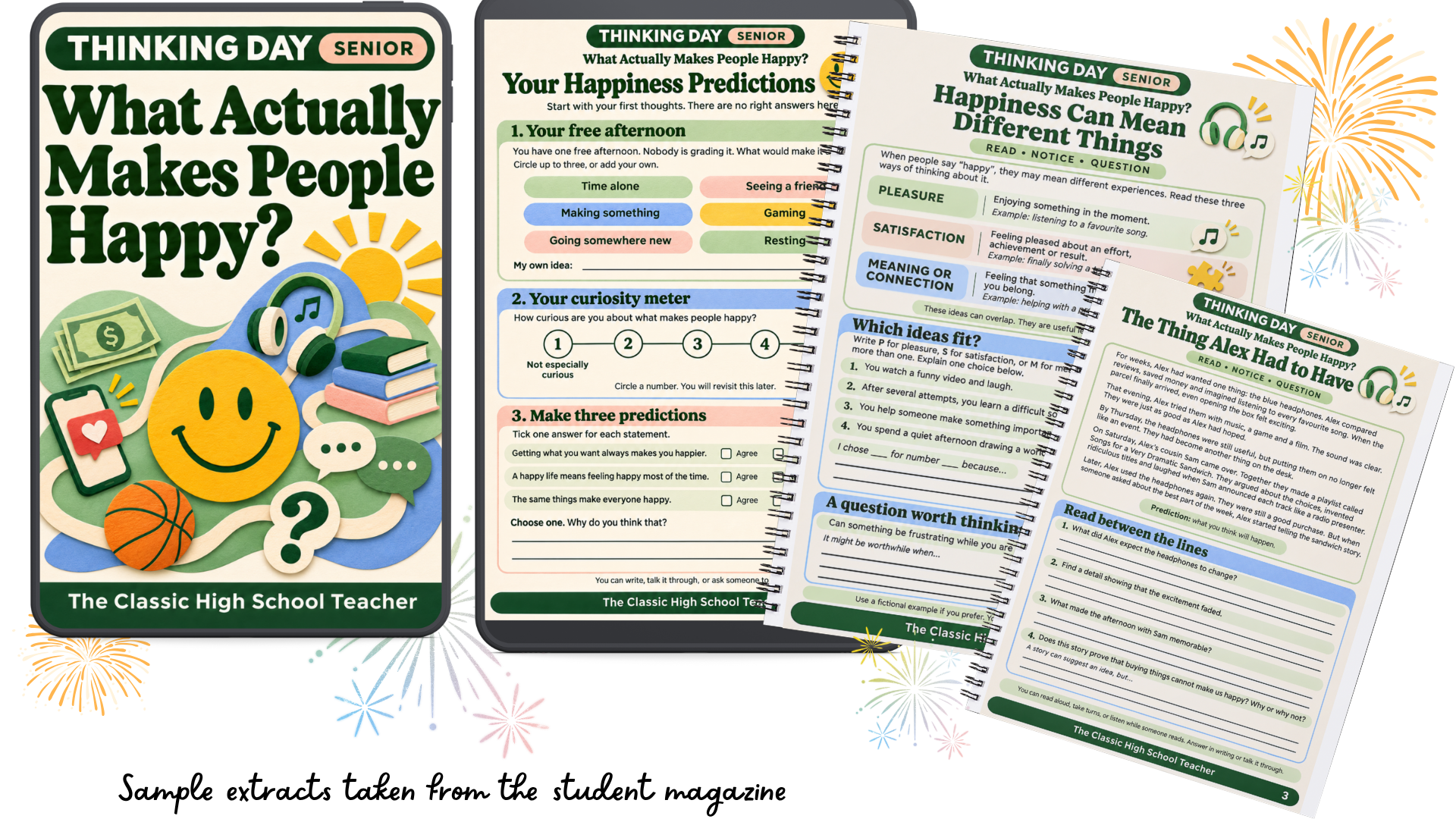
Thinking Day brings together reading, discussion, writing, curiosity meters, and challenges that help children explore ideas and explain their thinking.
They get opportunities to notice details, consider another perspective, support an opinion, and reflect on whether their view has changed.
Those are skills they can carry into other learning.
When your teen explains why two people could interpret the same situation differently, they’re practising the kind of thinking that helps with literary analysis.
When your younger child chooses an idea and gives a reason, they’re building a foundation for more developed explanations later.
The topic draws them in. The activities give their thinking somewhere to go.
Space for different kinds of learners
Some children want to talk an idea through before they can write about it.
Some need a small, visible first step. Others have plenty of ideas but feel overwhelmed when asked to put them all on paper.
Thinking Day is designed with neurodiverse learners in mind, with structured activities and opportunities to pause, discuss, and reflect.
At home, you can use that flexibility to respond to the child in front of you.
You might talk through a question first, let them sketch an idea, or begin with one sentence they feel ready to write.
The curiosity meters also invite them to notice their own response: What interests me? What am I unsure about? What would I like to explore further?
Their response becomes part of the learning.
Something that can spill beyond the workbook
The family challenges are one of my favourite parts.
They give an idea somewhere to travel after the page is finished.
A question can become a dinner-table conversation. An activity can prompt someone to ask a grandparent what they think. A discussion can reappear in the car two days later, when a child suddenly announces, “I’ve been thinking about that…”
Those moments matter.
They help children experience learning as something they can carry into their lives, share with other people, and keep coming back to.
One Family Pass. Both Junior and Senior.
If you’ve been looking at Thinking Day and wondering which level to choose for your household, the new Family Pass makes that decision easier.
You get access to both.
Choose a starting point that suits your family. Bring a little more curiosity into your week. Give your younger child something exciting to explore and your teen something worth having an opinion about.
You don’t need to plan an extraordinary homeschool day.
Sometimes, you just need a good question.
Explore the Thinking Day Family Pass and discover where the conversation takes your family.